
I nterventional gastrointestinal (GI) endoscopy has progressed from a primarily diagnostic procedure to a highly specialised therapeutic discipline that enables the minimally invasive management of a wide range of gastrointestinal diseases (Khan et al, 2025; Sharma et al., 2015). Advances such as high-definition imaging, Narrow Band Imaging (NBI), Endoscopic Ultrasound (EUS), Endoscopic Retrograde Cholangiopancreatography (ERCP), Endoscopic Mucosal Resection (EMR), Endoscopic Submucosal Dissection (ESD), and Per-Oral Endoscopic Myotomy (POEM) have improved diagnostic accuracy and expanded therapeutic options, reducing the need for many conventional surgical procedures (Khan et al, 2025). As these procedures have become more complex, the role of the endoscopy nurse has also expanded. In addition to preparing patients for procedures, nurses are now involved in preprocedure assessment, sedation monitoring, early identification of complications, post-procedure recovery, infection prevention, and coordination of multidisciplinary care (Jamil et al, 2020; ESGENA, 2008).
These evolving responsibilities require advanced knowledge, technical competence, and sound clinical judgment. More attention has been given on technological advances in interventional endoscopy than on the competencies required of nurses to support safe and effective practice. Current evidence on competency-based nursing roles is scattered, and there is limited discussion of standardised methods for assessing clinical competence in endoscopy settings. Particularly, the use of competency-based frameworks and Objective Structured Clinical Examination (OSCE) models for evaluating endoscopy nursing skills has not been comprehensively reviewed. Addressing this gap is important to support consistent training, competency assessment, and high-quality nursing practice.
This narrative review summarises recent advances in interventional GI endoscopy and examines the evolving roles and competencies of endoscopy nurses. It also explores the potential of competency-based frameworks and OSCE as approaches to strengthen nursing education, professional development, and patient safety in contemporary endoscopy practice (Rushforth, 2007; Selim et al, 2012). As it adopted a narrative approach, no formal quality assessment or riskof-bias evaluation of the included studies was performed. A literature search was conducted in PubMed/MEDLINE, Scopus, ScienceDirect, CINAHL, and Google Scholar for studies published between January 2008 and December 2025. Relevant guidelines from the American Society for Gastrointestinal Endoscopy (ASGE) and the European Society of Gastroenterology and Endoscopy Nurses and Associates (ESGENA) were also reviewed.The search combined Medical Subject Headings (MeSH) and free-text terms, including interventional endoscopy, gastrointestinal endoscopy, endoscopy nursing, nursing competency, ERCP, endoscopic ultrasound, sedation monitoring, endoscope reprocessing, infection prevention, OSCE, and competencybased training. Boolean operators (AND, OR) were used to combine search terms. For example, the PubMed search included: Gastrointestinal Endoscopy [MeSH] OR Endoscopy Nursing) AND Clinical Competence [MeSH] OR Nursing Competency AND Patient Safety OR Infection Prevention. Titles and abstracts were screened for relevance, followed by full-text review of potentially eligible articles. Peer-reviewed English-language articles, clinical guidelines, consensus statements, and publications related to competency-based nursing practice in interventional gastrointestinal endoscopy were included. Non-English articles, duplicate records, conference abstracts without full text, and studies not related to gastrointestinal endoscopy nursing were excluded. The selected literature was reviewed and grouped into key themes, including pre-procedure assessment, intra-procedure monitoring, post-procedure care, infection prevention, endoscope reprocessing, competency assessment, education and training, and quality assurance. Findings from research studies and professional guidelines were synthesised narratively to provide an overview of current nursing competencies and best practices in interventional gastrointestinal endoscopy.
The use of multiple databases, established eligibility criteria, and internationally recognised guidelines helped ensure a broad and balanced review of the available evidence. An interventional endoscopy procedure room must be carefully designed to support advanced therapeutic procedures while ensuring patient safety, infection control, ergonomic efficiency, and smooth workflow (Jamil et al, 2020). The room should be organised into clearly defined functional zones, including the clean zone is used for the storage and preparation of clean equipment and supplies. The procedure zone is where endoscopic procedures are performed and patients are monitored. The contaminated zone is designated for the handling and initial processing of used endoscopes and accessories before reprocessing. A recovery area, preferably in a separate room, should provide appropriate monitoring and supportive care until patients have safely recovered from the procedure and sedation.
Interventional endoscopy is a complex procedure that depends on effective teamwork and clear role allocation. Nurses contribute not only to procedural assistance but also to patient assessment, continuous monitoring, infection prevention, emergency preparedness, and quality assurance, making them integral to safe and efficient endoscopy services (ESGENA, 2008; Jamil et al, 2020). Appropriate positioning of team members within the procedure room facilitates communication, smooth instrument exchange, airway management, and timely response to emergencies. In routine practice, the endoscopist is positioned on the left side of the patient for optimal scope control, the assistant nurse stands on the right side to assist with instruments and patient monitoring; the anaesthesia provider remains at the head end to manage the airway and sedation, and the technician is stationed near the endoscopy tower to oversee equipment and provide technical support. The evolution of interventional endoscopy from diagnostic visualisation to complex therapeutic intervention has significantly expanded the clinical responsibilities of nursing professionals.
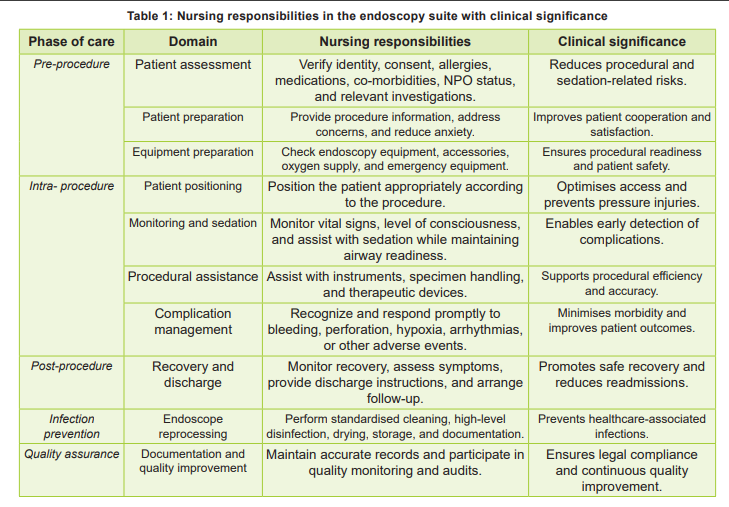
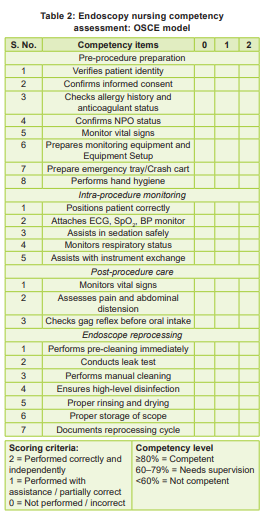
Endoscopy nursing practice extends across the pre-procedural, intra-procedural, and postprocedural continuum, incorporating patient safety, technical proficiency, infection control, and quality assurance. With the increasing complexity of procedures, the role of the nurse has expanded significantly beyond traditional assistance to encompass comprehensive patient assessment, sedation monitoring, infection prevention, complication recognition, quality assurance, and patient education. Competency-based nursing practice in the endoscopy unit is therefore essential to ensure patient safety, procedural efficiency, and optimal clinical outcomes. A structured framework outlining nursing responsibilities across the pre-procedure, intra-procedure, and post-procedure phases supports standardised care delivery and strengthens the overall safety culture within the endoscopy suite (Table 1) along with its OSCE model in Table 2; both are adapted from ASGE staffing recommendations (Jamil et al, 2020), ESGENA Core Curriculum (2008), and WHO reprocessing recommendations (World Health Organization, 2016).
Development of the Proposed OSCE Competency Checklist
The proposed OSCE competency checklist was developed based on evidence from the published literature and recommendations from international professional societies, including ESGENA, ASGE, and SGNA. The competency items were selected to represent the essential responsibilities of endoscopy nurses throughout the patient's journey, covering pre-procedure preparation, intra-procedure monitoring, postprocedure care, and endoscope reprocessing. These domains reflect the knowledge, technical skills, and safety practices expected in contemporary endoscopy units. Each item is scored using a three-point scale: 0 = not performed, 1 = partially performed or performed with assistance, and 2 = performed correctly and independently. The scoring system is simple, practical, and allows assessors to identify both competent performance and areas where further learning or supervision may be needed. As the checklist is intended as a proposed educational framework, it should be reviewed by a panel of experts, including experienced endoscopy nurses, gastroenterologists, nurse educators, and infection prevention specialists, to ensure that the items are relevant, clear, and consistent with current practice. Pilot testing in simulated or clinical settings is also recommended to assess its feasibility and consistency between assessors. Future research should focus on establishing the checklist's validity and reliability before it is adopted for routine competency assessment in endoscopy nursing education and practice.
Increasing procedural complexity requires nurses to integrate technical proficiency, clinical assessment, patient monitoring, infection prevention, and multidisciplinary coordination to maintain procedural safety and optimise patient outcomes. The findings are consistent with recommendations from the ASGE and the ESGENA core curriculum, both of which emphasise the importance of competency-based education, patient safety, sedation monitoring, and infection prevention in endoscopy nursing practice (Jamil et al, 2020; ESGENA, 2008). Comprehensive preprocedure assessment contributes significantly to reducing peri-procedural complications by identifying anticoagulant use, co-morbidities, allergic reactions, and sedation-related risks. Similarly, continuous intra-procedure monitoring
facilitates early recognition of hypoxia, bleeding, arrhythmias, and haemodynamic instability during advanced procedures such as ERCP, EUS-guided interventions, and ESD (Jamil et al, 2020). Strict adherence to endoscope reprocessing protocols remains essential for minimising cross-contamination and multidrugresistant organism transmission (World Health Organization, 2016; Calderwood et al, 2018). Existing literature daemonstrates that inadequate reprocessing practices are frequently associated with insufficient staff training and non-compliance with standardised protocols. The review further emphasises the importance of OSCE-based competency assessment models. Compared with traditional observational methods, simulation-based and OSCE-oriented approaches provide more objective evaluation of clinical skills, communication, technical proficiency, and emergency preparedness (Rushforth, 2007; Selim et al, 2012). Despite advancements in endoscopy nursing practice, several challenges persist, including staffing shortages, high workload, ergonomic strain, rapid technological advancement, infectioncontrol burden, and medico-legal accountability. Addressing these issues requires institutional support, continuing professional development, and standardised competency frameworks. From a clinical perspective, the proposed competency framework may be incorporated into orientation programmes for newly appointed endoscopy nurses, annual competency assessments, credentialing processes, and continuing professional development activities. The use of structured competency checklists, simulation-based training, and workplace-based assessments can facilitate consistent clinical practice, identify individual learning needs, and promote adherence to evidence-based standards (Frank et al, 2010; Frank et al, 2017).
In nursing education, the framework can inform curriculum design by integrating competency-based learning outcomes, simulation exercises, OSCEs, and supervised clinical placements. Such approaches help bridge the gap between theoretical knowledge and clinical practice while preparing nursing students for the increasing complexity of advanced endoscopy care (Rushforth, 2007; Selim et al, 2012). Successful implementation, however, requires institutional commitment, faculty development, adequate staffing, access to continuing professional education, and regular competency evaluation to ensure sustained improvements in patient safety and quality of care (Van Melle et al., 2019; World Health Organisation, 2021). Existing international guidelines developed by the ASGE, the European Society of Gastroenterology Nurses and Associates (ESGENA), and the Society of Gastroenterology Nurses and Associates (SGNA) provide comprehensive recommendations on patient safety, infection prevention, staffing, sedation monitoring, and educational requirements for endoscopy nurses (Jamil et al, 2020; ESGENA, 2008; SGNA, 2022). However, these guidelines primarily describe recommended standards of practice and professional responsibilities rather than offering a structured competency framework that integrates the knowledge, technical skills, clinical judgement, and professional behaviours required throughout the continuum of advanced interventional endoscopy care. The framework proposed in this review builds on these international recommendations by bringing together competencies across the pre-procedure, intra-procedure, and postprocedure phases of care into a single model. It also emphasises non-technical competencies, including communication, teamwork, patient advocacy, quality improvement, and emergency preparedness, which are increasingly recognised as essential components of safe endoscopy practice. By incorporating competency-based assessment strategies, such as simulation and OSCEs, the framework provides a practical approach for evaluating clinical performance in addition to theoretical knowledge (Rushforth, 2007; Selim et al, 2012).
The proposed framework has potential applications in both clinical practice and nursing education. In clinical settings, it may be used to support orientation programmes for newly appointed endoscopy nurses, guide competency assessment, identify learning needs, and inform continuing professional development. Within nursing education, the framework can assist educators in designing competency-based curricula that combine classroom learning with simulation and supervised clinical practice, thereby preparing graduates for the increasing complexity of interventional endoscopy (Frank et al, 2010). Despite these potential applications, the framework should be interpreted in light of several limitations. It was developed through a narrative review and therefore reflects the available literature without a formal assessment of methodological quality. In addition, much of the existing evidence originates from international guidelines and expert consensus, while studies evaluating standardised competency assessment tools specifically for advanced interventional endoscopy nursing remain limited. This highlights a gap in the evidence base and the need for further research. Future studies should focus on validating the proposed competency domains using expert consensus methods, such as Delphi studies, and evaluating their implementation in different healthcare settings.
The development of standardised assessment instruments and multicentre implementation studies would provide stronger evidence regarding the framework's feasibility, reliability, and impact on nursing competency, patient safety, and procedural quality. Such work would contribute to the continued development of interventional endoscopy nursing as a specialised area of clinical practice.
Challenges for Nursing Professionals
The rapid evolution of interventional endoscopy has considerably expanded the role of nurses in delivering safe and effective patient care. As procedures become more complex, nurses are expected to possess advanced technical skills, sound clinical judgement, and the ability to anticipate and respond to procedure-related complications (Jamil et al, 2020; ESGENA, 2008). Responsibilities related to procedural sedation have also increased, requiring continuous patient monitoring and timely recognition of adverse events (Dumonceau et al, 2015). Maintaining high standards of infection prevention through meticulous endoscope reprocessing remains a critical responsibility and demands strict adherence to established protocols (Calderwood et al, 2018; World Health Organization, 2016).
Further, nurses involved in fluoroscopyguided procedures must consistently implement radiation safety measures to minimise occupational exposure (International Commission on Radiological Protection, 2018). These responsibilities are compounded by workforce shortages, heavy clinical workloads, rapid technological advances, and increasing medico-legal accountability, all of which can affect both staff wellbeing and the quality of patient care (World Health Organization, 2021).
Nursing Implications: This review highlight the need for competency-based preparation of nurses working in interventional endoscopy. Education and training should extend beyond technical skills to include clinical decision-making, patient assessment, sedation monitoring, infection prevention, and the early identification and management of complications. In clinical settings, nurses should actively contribute to patient safety by following standardised protocols, participating in quality improvement activities, maintaining accurate documentation, and promoting effective communication. Continuous professional development is equally important to keep pace with emerging technologies and evolving clinical guidelines. Investment in workforce development, adequate staffing, and occupational health measures including radiation protection, ergonomic practices, and fatigue management—is essential to support both nurse wellbeing and high-quality patient care (World Health Organization, 2021). These measures will strengthen the role of endoscopy nurses and facilitate the delivery of safe, evidence-based, and patient-centred care.
Limitations:
This review is limited by its narrative design, which may have introduced selection bias, and the absence of a formal quality appraisal of the included literature. Only English-language publications were reviewed, potentially excluding relevant evidence from other sources. There is limited nursing-specific evidence on standardised competency assessment in advanced interventional endoscopy, and the proposed competency framework has not yet been evaluated in clinical practice.
Future Directions: Future studies should validate the proposed competency framework in clinical and educational settings and develop standardised competency assessment and certification pathways for endoscopy nurses. Expanding simulationbased training and OSCEs, alongside the use of digital technologies for competency tracking, may strengthen workforce preparedness. Further research should also examine strategies to enhance infection prevention, sedation safety, and interdisciplinary collaboration in advanced endoscopy practice.
Conclusion
Advanced interventional gastrointestinal endoscopy requires highly competent nursing professionals capable of integrating technical expertise, patient safety monitoring, infection prevention, and multidisciplinary coordination. Structured competency-based education and OSCE-based assessment frameworks can strengthen professional accountability, improve procedural safety, and enhance the quality of patient-centred endoscopy care. Recognition of endoscopy nursing as a specialised practice domain is essential to support workforce preparedness and the future advancement in gastrointestinal endoscopy services.
1. American Society for Gastrointestinal Endoscopy. (n.d.). ASGE guidelines. Retrieved 29 May 2026. https://www. asge.org/home/resources/publications/guidelines
2. American Society for Gastrointestinal Endoscopy. (n.d.). Nursing services: ASGE policy and procedure reference guide. Retrieved May 29, 2026, from https://www.asge. org/home/practice-support/practice-resources/asgepolicy-procedure-reference-guide/nursing-services
3. Calderwood AH, Day LW, Muthusamy VR, Collins J, Hambrick R D, Brock AS, et al. ASGE guideline for infection control during GI endoscopy. Gastrointestinal Endoscopy 2018; 87(5): 1167-79. https://doi. org/10.1016/j.gie.2017.12.009
4. Dumonceau JM, Riphaus A, Schreiber F, Vilmann P, Beilenhoff U, Aparicio JR, et al. Non-anesthesiologist administration of propofol for gastrointestinal endoscopy: European Society of Gastrointestinal Endoscopy (ESGE) guideline June 2015. Endoscopy 47 (12), 1175-89. https:// doi.org/10.1055/s-0034-1393414
5. European Society of Gastroenterology Nurses and Associates. ESGENA Core curriculum for endoscopy nursing. Published by ESGENA Secretariat, Sept 2008
6. Frank JR, Snell LS, Cate OT, Holmboe ES, Carraccio C, Swing SR, et al. Competency-based medical education: Theory to practice. Medical Teacher 2010: 32 (8): 638-45. https://doi.org/10.3109/0142159X.2010.501190
7. Frank JR., Snell L, Englander R, Holmboe ES. Implementing competency-based medical education: Moving forward. Medical Teacher 2017; 39 (6): 568-73. https://doi.org/10.1 080/0142159X.2017.1315067
8. International Commission on Radiological Protection. Occupational radiological protection in interventional procedures (ICRP Publication 139). Annals of the ICRP 2018; 47(2): 1-118
9. Jamil LH, Naveed M, Agrawal D, Fujii-Lau LL, Al-Haddad M, Buxbaum JL, et al. ASGE guideline on minimum staffing requirements for the performance of GI endoscopy. Gastrointestinal Endoscopy 2020; 91 (4): 723-29
10. Khan H, Slomovich S, Shah NC, Gress FG. Interventional endoscopic ultrasonography: Advances in application. Journal of Clinical Medicine 2025; 14(10): 3286. https://doi. org/10.3390/jcm14103286
11. Rushforth HE. Objective structured clinical examination (OSCE): Review of literature and implications for nursing education. Nurse Education Today 2007; 27 (5): 481-90. https://doi.org/10.1016/j.nedt.2006.08.009
12. Selim AA, Ramadan FH, El-Gueneidy MM, Gaafer MM. Using objective structured clinical examination (OSCE) in undergraduate psychiatric nursing education: Is it reliable and valid? Nurse Education Today 2012; 32(3): 283-88. https://doi.org/10.1016/j.nedt.2011.04.006
13. Susan B, Loyola CM, Benitez-Romero M, Friis CM, Granato A, Penberthy J, et al. Standards of clinical nursing practice and role delineations in the gastroenterology setting. Society of Gastroenterology Nurses and Associates. Gastroenterology Nursing 2018; 43(3): E129-41. DOI:10.1097/SGA.0000000000000535
14. Sharma V, Rana SS, Bhasin DK. Endoscopic ultrasoundguided interventional procedures. World Journal of Gastrointestinal Endoscopy 2015; 7(6): 628-42
15. Van Melle E, Frank JR, Holmboe ES, Dagnone D, Stockley D, Sherbino J, et al. A core components framework for evaluating implementation of competency-based medical education programs. Academic Medicine 2019; 94 (7): 1002- 1009. https://doi.org/10.1097/ACM.0000000000002743
16. Wexner SD, Eisen GM, Baron TH, et al. A consensus document on bowel preparation before colonoscopy: Prepared by a task force from the American Society of Colon and Rectal Surgeons, the American Society for Gastrointestinal Endoscopy, and the Society of American Gastrointestinal and Endoscopic Surgeons Gastrointestinal Endoscopy 2016; 63(7): 894-909. https://doi.org/10.1016/j. gie.2006.03.919
17. World Health Organization. Decontamination and Reprocessing of medical devices for Health-Care Facilities. World Health Organization, 2016
18. World Health Organization. Global strategic directions for nursing and midwifery 2021–2025. World Health Organization, 2021

This work is licensed under a Creative Commons Attribution-NonCommercial-ShareAlike 4.0 International License.