
Achatbot is a software application designed to simulate conversations with users. While not all chatbots rely on artificial intelligence (AI), modern chatbots are increasingly using conversational AI methods, such as natural language processing (NLP) to understand user queries and generate automated responses (IBM, 2021). The introduction of ChatGPT 3.5 in November 2022 sparked widespread interest in the potential of AI chatbots in higher education. As we progressed into 2024, AI chatbots such as GPT-4o, Gemini 1.5 Pro, and Claude 3 started driving advancements in technology through the use of deep learning techniques (Schei et al, 2024). The use of AI chatbots has increased significantly during Covid-19 pandemic and is still growing. The global chatbot market is projected to reach a value of USD 3.99 billion by 2030 (Gkinko & Elbanna, 2022).
Many companies now use chatbots to help their customers. The round-the-clock availability makes it easier for customers to get help when they need it, which in turn boosts their overall satisfaction (Adamopoulou & Moussiades, 2022).
Young people including nursing students turn to AI in all kinds of ways in their daily lives. At colleges, they use it to look up information, and as a general study aid. Outside the classroom, AI becomes more of a personal assistant, helping them plan meals or workouts, suggesting movies to watch, or even pointing them towards fun activities nearby. Sometimes, they also lean on AI for something as simple as finding the right words when chatting or expressing themselves (The Nordic Youth Barometer, 2023
Despite the growing prevalence and impact of ChatGPT in educational settings, various stakeholders and academics are expressing their concerns. Sophisticated AI tools present a notable challenge, as they can closely replicate students' work. This situation raises alarms about undetectable plagiarism and dishonest practices, calling for a reassessment of established evaluation techniques (Stohr et al, 2024). To better understand how young people including nursing students engage with all AI chatbots, it’s important to look at: what they know about them, how they feel about them, and how they use them in general.
Need of the study: Since nursing education primarily emphasises practical and clinical skills, it becomes essential to assess their awareness, attitudes, and practices towards AI chatbots to bridge this gap and enhance their digital competency.
Global Scenario According to Exploding Topics (2025), over 987 million people worldwide currently use AI chatbots. Nearly 35 percent of these users prefer chatbots over search engines when seeking answers. Beyond just answering questions, many people turn to chatbots for creative and practical help. In fact, about 23 percent of users say they’ve used them to write, re-write, or edit content in order to get a task done. The global AI chatbot market dramatically increased from USD 2.47 billion in 2021 to around USD 15.57 billion in 2025.
In US, 53 percent of 1,200 ChatGPT responses were harmful. Of these, 47 percent encouraged further engagement in harmful topics. Among young people who have tried AI companions, just over half (52%) are considered regular users. For many teens, these interactions go beyond casual curiosity; a third of them report turning to AI companions for social connection and relationships. This often includes seeking emotional or mental health support, building a sense of friendship, or even exploring romantic interactions (Center for Countering Digital Hate, 2025). Frontiers in Artificial Intelligence (2024) reported that among selected Swedish schools about 15 percent of younger teens used ChatGPT or similar tools for their schoolwork, while the usage rate among older teens was much higher (around 53%). Students who had trouble focusing or organising their tasks found AI more helpful compared to those with stronger thinking abilities (Klarin et al, 2024).
Review of Literature
In a cross-sectional study to evaluate the knowledge, attitudes, and practices regarding AI technology, specifically ChatGPT on 304 nursing students from Palestinian universities, Salama Nisreen et al (2025) conducted used convenience sampling with participants completing a self-administered questionnaire. Results showed that 84.5 percent of the students were aware of AI, but only 69.9 percent had received formal training on the subject. 79 percent of the students expressed support for integrating AI into nursing education, and 58.6 percent had used AI tools in their studies. Rahman et al (2025) conducted a cross-sectional study to investigate the student’s mindset to adopt AI chatbots for effectiveness of online learning in higher education among 429 university students in Malaysia. Results showed that 70.2 percent had moderate technology skills, 22.6 percent had high-level skills, and 7.2 percent had low-level skills. Most students accessed the internet via mobile hotspots (54.7%) rather than home Wi-Fi (45.3%).
In a descriptive study at Politehnica Bucharest, Vieriu & Petrea (2025) assessed the impact of AI on students' academic development among 85 second-year engineering students. The sample was collected through a structured questionnaire by using a purposive sampling technique. Results showed that 95.6 percent of respondents use AI in academic activities, with 82.4 percent believing that AI enhances academic performance. However, 15.3 percent saw no significant changes, 3.5 percent felt it limited knowledge acquisition, and 2.4 percent found AI to be of no benefit.
In a cross-sectional study, Kharroubi et al (2024) explored the knowledge, attitude, and practices towards AI among 480 university students in Lebanon. The sample was collected through formulated questionnaire and sent out via social media platforms. Results showed that 97.2 percent participants were familiar with AI, and their attitude towards AI's role in academic and professional paths was moderately satisfactory (43%).
Steward et al (2024) conducted a survey-based descriptive cross-study, to assess the knowledge, attitudes and practices regarding AI among 262 pharmacy students at the University of Zambia to raise awareness and also suggests integrating AI into pharmacy curricula and professional programmes. Results showed that 71.3
percent had inadequate knowledge, 71.3 percent negative attitudes, and 51.7 percent had suboptimal practices towards AI.
Objectives
The study was carried out to:
1. Develop tool to assess the (a) knowledge, (b) attitude, and (c) practice of young adults towards using Al chatbots;
2. Determine the association of (a) knowledge, (b) attitude, and (c) practice of young adults towards using Al chatbots with the selected socio-demographic variables; and
3. Disseminate the findings.
Materials and Methods
Quantitative research approach with descriptive research design was used in the present study. The target population was young adults aged 18 to 30, of selected Nursing Colleges of district Mohali (Punjab). The sample comprised of 200 students from selected Nursing colleges of district Mohali. Cochran formula was applied using finite population correction. To collect the sample, convenient sampling technique was used.
Inclusion & Exclusion Criteria Both male and female Nursing students in age range 18 - 30 years, and willing to participate in the study were included.
Students below 18 years and above the age of 30 years, and those not present at the time of data collection were excluded.
Tools Used
Section A. Socio-demographic variables: Sociodemographic variables of students: Age, gender, course of study, year/semester of study, marital status, residential area, type of family, education of father, education of mother, occupation of father, occupation of mother, monthly income, frequency of internet use per day, source of information about AI chatbots.
Section B. Knowledge Questionnaire: A questionnaire to assess the knowledge of young adults towards using AI chatbot. It consists of 15 multiple choice questions (closed-ended questions). Criteria to measure the knowledge level: Score 11-15 Good; 6-10 Average; 0-5 Poor
Section C. Attitude scale: Attitude scale to assess the attitude of young adults towards using AI chatbot is a 5-pointer scale with 7 positive statements and7 negative statement and marks ranging from 1 to 5 and 5 to 1 respectively.
Criteria to measure the attitude: Score 36-70 Positive attitude; 1-35 Negative attitude
Section D. Practice Questionnaire: Meant to assess the practices of young adults towards using AI chatbot, it consists of 20 closed-ended question i.e. Yes or No, where No is marked as 0 and Yes is marked as 1.
Criteria to measure the practice: Score 0-10 Less; 11-20 More
Validity of Tools
The prepared tools which include a knowledge questionnaire, attitude scale and practice questionnaire regarding AI chatbots, were given to experts from the nursing field for the content validity. All suggestion of tool were consolidated, and final tool was prepared after consultation with the research supervisor.
Pilot study
The pilot study was conducted at selected Nursing college of district Mohali (Punjab). The sample taken was 10 percent of total sample that is 20 young adults.
Reliability of tools
Reliability of data collection tools was calculated by using Split half method and Cronbach’s Alpha statistical formula. The Reliability of tools was 0.7.
Ethical considerations
Ethical clearance was obtained from the institutional ethical committee, and permissions obtained from college authorities. Anonymity and confidentiality of the participants were maintained during the study. Informed consents were taken from the individual subjects. The study did no harm the emotional feelings of subjects, and no discrimination was done on the basis of caste, colour, sex, while collecting data.
Results
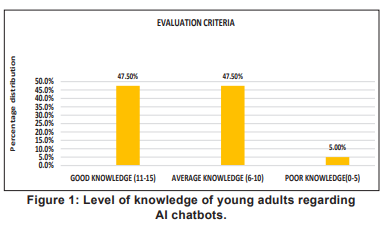
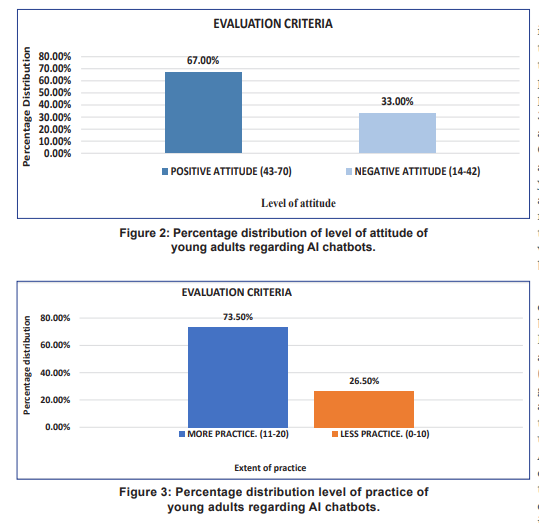
In this study, nearly half of the participants (47.5%) demonstrated good knowledge, an equal proportion (47.5%) had average knowledge, and 5 percent only had poor knowledge. Further, majority of students subjects (67.0%) had a positive attitude, while 33 percent had a negative attitude towards AI Chatbots. Most participants (73.5%) demonstrated a high level of practice, while 26.5 percent had lower practice scores.
Table 1 and Fig 1 depict the association between selected demographic variables and knowledge.
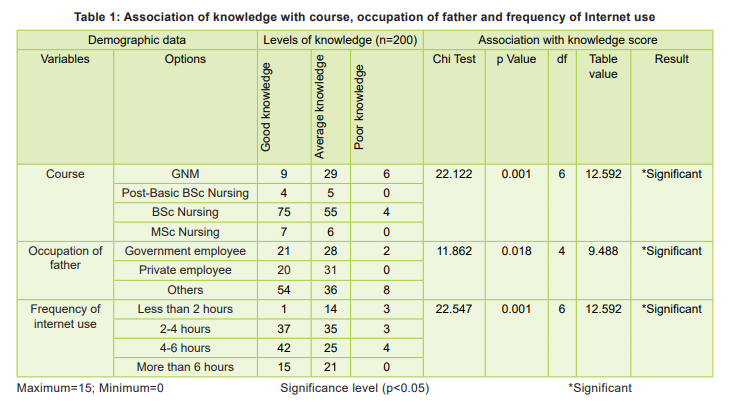
A statistically significant association was observed between course and knowledge level (χ2 =22.122, p=0.001), between occupation of father and knowledge level χ2=11.862, p=0.018) and between frequency of internet use and knowledge level (χ2=22.547, p=0.001).
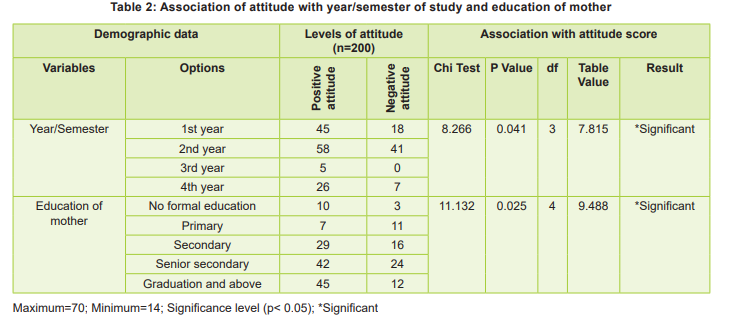
A statistically significant association was observed between year/semester of study and attitude levels (χ2 =8.266, p=0.041) and between education of mother and attitude levels (χ2=11.132, p=0.025) (Table 2).
Discussion
In a cross-sectional design AI study of 220 nursing students from a King Khalid University college, using convenience sampling, El-Maksoud (2024) found that 68.2 percent of the nursing students had good knowledge about Artificial Intelligence, 40.8 percent had average knowledge, and 38.6 percent had poor knowledge. In the present study, nearly half the participants (47.5%) demonstrated good knowledge, an equal number (47.5%) had average knowledge, and 5 percent only had poor knowledge. There was a significant association between the course (p=0.001), the occupation of the father (p=0.018), and frequency of internet use (p=0.001) with the variables while other variables were found to be non-significant.
Employing a cross-sectional model for 1,243 nursing students selected from seven regions of China, Wang & Fei (2024) investigated their level of attitude regarding AI. The study results revealed that 57 percent students had good knowledge, 64.7 percent had average knowledge, and 4.7 percent had poor knowledge.
Further investigation in our study of assessing the attitude revealed that the majority of 67.0 percent students had a positive attitude, while 33 percent had a negative attitude towards AI Chatbots. Also, there was a significant association of year/semester (p=0.041) and the education of the mother (p=0.025) with the variables while other variables were found to be non-significant.
Two studies were conducted encompassing both younger (Study 1: N = 385, 46% girls, mean age 14 years) and older (Study 2: N = 359, 67% girls, mean age 17 years) adolescents to explore their use and perceived usefulness of generative AI for schoolwork, and comprehensively examine the associations across different age groups (Klarin et al, 2024). In Study 1, approximately 14.8 percent of participants reported using generative AI, while in Study 2, the adoption rate among older students was 52.6 percent, with ChatGPT emerging as the preferred tool among adolescents in both studies. In the present study of assessing the practice, most participants (73.5%) demonstrated a high level of practice, while 26.5 percent had lower practice scores. The results of the study show that there is no significant association with variable.
Implications of the Study
On nursing education: Considering a knowledge gap about AI chatbots among young nurses, colleges can introduce the foundational concepts and the practical application of chatbots in the syllabus. Workshops/seminars/training can be planned to inculcate training among students regarding the effective use of chatbots for studies and clinical learning.
Nursing research: The findings could serve as a foundation for further research on AI chatbots in Nursing. The researchers can explore how chatbots improve learning, problem-solving and decision-making among young adults. The comparison can be made with other nursing colleges or a large number of young adults as part of future research.
Nursing practices: AI chatbots can help young adults in clinical decision support and patient education serving as rapid references to assist practitioners with drug information, care recommendations, and health information. It is important to encourage safe, ethical, and responsible chatbots among young adults.
Nursing administration: Administrators can use these findings to plan awareness campaigns and training modules on AI chatbot usage for nursing students and faculty. Policies and guidelines can be developed to ensure appropriate, ethical, and responsible integration of chatbots in nursing education and clinical environments. Institutions may consider collaborating with technology developers to design customised chatbots tailored to nursing education and healthcare needs.
Recommendations
A similar study can be replicated on a large sample to generalise the findings. The study can be conducted in different settings. Instead of a descriptive study, an exploratory study can also be conducted. A variant group of professionals can be included.
Limitations
The limited period of study offered constraints in making the findings more generalised, valid and specific as it was limited to 200 students of selected nursing colleges of district Mohali (Punjab).
Conclusion
A majority of students were having good as well as average level of knowledge, positive attitude and higher practice of AI chatbots of young adults of selected nursing colleges of district Mohali. There was a significant association between the course (p=0.001), the occupation of the father (p=0.018), and frequency of internet use (p=0.001) with the variables. Our study shows significant association of year/semester (p=0.041) and the education of the mother (p=0.025) with the variables while other variables were found to be non-significant.
The association between demographic data and practice of AI chatbots among participants. The stydy whosws no significant association with variable.
1. Schei OM, Mogelvang A, Ludvigsen K. Perceptions and use of AI chatbots among students in higher education. Education Sciences 2024; 14(8): 922. Available at https:// doi.org/10.3390/educsci14080922
2. Gkinko L, Elbanna A. AI Chatbots sociotechnical research: An overview and Future Directions. In Proc 8th International Workshop on Socio-Technical Perspectives in IS Development (STPIS’22), 19-21 Aug 2022. 3229, 173-8
3. Available at https://ceur-ws.org/Vol-3229/ paper17 3. IBM. What is a chatbot? 2021, October 15. Available at https://www.ibm.com/think/topics/chatbots
4. Adamopoulou E, Moussiades L. Chatbots: History, technology, and applications. Machine Learning with Applications 2020; 2: Available at https://doi. org/10.1016/j.mlwa.2020.100006
5. The Nordic Youth Barometer, 2023. Back2School. Available at https://info.ungdomsbarometern.se/publikarapporter/back2school-2023
6. Stohr C, Ou AW, Malmstrom A. Perceptions and usage of AI chatbots among students in higher education across genders, academic levels, and fields of study. Computers & Education Artificial Intelligence 2024; 7: 100259. https://doi.org/10.1016/j.caeai.2024.100259
7. Exploding Topics. 40+ chatbot statistics & trends. Retrieved from https://explodingtopics.com/blog/chatbotstatistics AI technology (ChatGPT) among nursing students at Palestinian universities. BMC Nursing 2025; 24, Article 269. Available at https://doi.org/10.1186/ s12912-025-02913-4
8. Center for Countering Digital Hate.2025. Fake Friend: How ChatGPT betrays vulnerable teens by encouraging dangerous behaviour. Published 6 August 2025. https:// counterhate.com
9. Klarin J, Hoff Eva, Adam Larsson, Daiva Daukantaite. Adolescents’ use and perceived usefulness of generative AI for schoolwork: Exploring their relationships with executive functioning and academic achievement. Frontiers in Artificial Intelligence, Sec. AI for Human Learning and Behavior Change 2024, 28 Aug; 7. https:// doi.org/10.3389/frai.2024.1415782
10. Rahman MK, Ismail NA, Hossain MA, Hossen MS. Students’ mindset to adopt AI chatbots for effectiveness of online learning in higher education. Future Business Journal 2025; 11(30). Available at https://doi.org/10.1186/ s43093-025-00459-0
11. Vieriu AM, Petrea Gabriel. The impact of Artificial Intelligence (AI) on students’ academic development. Education Sciences 2025; 15(3): 343. Available at https:// doi.org/10.3390/educsci15030343
12. Kharroubi SA, Tannir I, Abu El Hassan R, Ballout R. Knowledge, attitude, and practices toward Artificial Intelligence among university students in Lebanon. Education Sciences 2024; 14(8): 863. Available at https:// doi.org/10.3390/educsci14080863
13. Mudenda Steward, Lubinda Ruth, Ksanga Maisa, Musakuzi Zanga, Mohamed S, Mufwambi Webrod. Artificial Intelligence: A knowledge, attitudes, and practices survey among pharmacy students at the University of Zambia. Creative Education 2024; 15(12): 2582-96. DOI: 10.4236/ce.2024.1512157
14. Abd El-Maksoud MM. Nursing students’ knowledge and attitude regarding integration of artificial intelligence in healthcare; Tuijin Jishu/Journal of Propulsion Technology 2024; 45(2): 5264. Available at https://www.researchgate. net/publication/381323208_Nursing_Students'_ Knowledge_and_Attitude_Regarding_Integration_of_ Artificial_Intelligence_in_Healthcare
15. Xiaoyan Wang, Fangqin Fei. Kno wledge and attitudes toward artificial intelligence in nursing among various categories of professionals in China: A cross-sectional study. Front Public Health 2024; 12. Available at https:// doi.org/10.3389/fpubh.2024.1433252
16. Schei OM, Mogelvang A, Ludvigsen K. Perceptions and use of AI chatbots among students in higher education. Education Sciences 2024; 14(8): 922. Available at https:// doi.org/10.3390/educsci14080922
17. Gkinko L, Elbanna A. AI Chatbots sociotechnical research: An overview and Future Directions. In Proc 8th International Workshop on Socio-Technical Perspectives in IS Development (STPIS’22), 19-21 Aug 2022. 3229, 173-83. Available at https://ceur-ws.org/Vol-3229/ paper17
18. IBM. What is a chatbot? 2021, October 15. Available at https://www.ibm.com/think/topics/chatbots
19. Adamopoulou E, Moussiades L. Chatbots: History, technology, and applications. Machine Learning with Applications 2020; 2: Available at https://doi. org/10.1016/j.mlwa.2020.100006
20. The Nordic Youth Barometer, 2023. Back2School. Available at https://info.ungdomsbarometern.se/publikarapporter/back2school-2023
21. Stohr C, Ou AW, Malmstrom A. Perceptions and usage of AI chatbots among students in higher education across genders, academic levels, and fields of study. Computers & Education Artificial Intelligence 2024; 7: 100259. https://doi.org/10.1016/j.caeai.2024.100259
22. Exploding Topics. 40+ chatbot statistics & trends. Retrieved from https://explodingtopics.com/blog/chatbotstatistics AI technology (ChatGPT) among nursing students at Palestinian universities. BMC Nursing 2025; 24, Article 269. Available at https://doi.org/10.1186/ s12912-025-02913-4
23. Center for Countering Digital Hate.2025. Fake Friend: How ChatGPT betrays vulnerable teens by encouraging dangerous behaviour. Published 6 August 2025. https:// counterhate.com
24. Klarin J, Hoff Eva, Larsson Adam, Daiva Daukantaite. Adolescents’ use and perceived usefulness of generative AI for schoolwork: Exploring their relationships with executive functioning and academic achievement. Frontiers in Artificial Intelligence 2024, 28 Aug; 7. https:// doi.org/10.3389/frai.2024.1415782
25. Rahman MK, Ismail NA, Hossain MA, Hossen MS. Students’ mindset to adopt AI chatbots for effectiveness of online learning in higher education. Future Business Journal 2025; 11(30). Available at https://doi.org/10.1186/ s43093-025-00459-0
26. Vieriu AM, Petrea Gabriel. The impact of Artificial Intelligence (AI) on students’ academic development. Education Sciences 2025; 15(3): 343. Available at https:// doi.org/10.3390/educsci15030343
27. Kharroubi SA, Tannir I, Abu El Hassan R, Ballout R. Knowledge, attitude, and practices toward Artificial Intelligence among university students in Lebanon. Education Sciences 2024; 14(8): 863. Available at https:// doi.org/10.3390/educsci14080863
28. Mudenda Steward, Lubinda Ruth, Ksanga Maisa, Musakuzi Zanga, Mohamed S, Mufwambi Webrod. Artificial Intelligence: A knowledge, attitudes, and practices survey among pharmacy students at the University of Zambia. Creative Education 2024; 15(12): 2582-96. DOI: 10.4236/ce.2024.1512157
29. Abd El-Maksoud MM. Nursing students’ knowledge and attitude regarding integration of artificial intelligence in healthcare; Tuijin Jishu/Journal of Propulsion Technology, 2024; 45(2): 5264. Available at https://www.researchgate. net/publication/381323208_Nursing_Students'_ Knowledge_and_Attitude_Regarding_Integration_of_ Artificial_Intelligence_in_Healthcare
30. Xiaoyan Wang, Fangqin Fei. Kno wledge and attitudes toward artificial intelligence in nursing among various categories of professionals in China: A cross-sectional study. Front Public Health 2024; 12. Available at https:// doi.org/10.3389/fpubh.2024.1433252

This work is licensed under a Creative Commons Attribution-NonCommercial-ShareAlike 4.0 International License.