
Leadership is not about position; it’s about action. Nurses at all levels have to be leaders because they lead health care. Nurse leaders are vital for health care as they constantly influence people by their actions and are in key position in health care services. WHO report (2025) strongly advocates investment in students’ education and dedicated leadership development for nurses which is a strategic priority for strengthening health systems. As nursing is a feminised work force, the share of leadership positions is important to empower women nurses in work place. Development of nursing leadership at country, regional and global level has been stated as one of the policy options. Both 2020 and 2025 reports emphasised the need for leadership development in nursing.
Upon graduation, nursing students must be ready to take up the responsibilities of a professional nurse (Mohammadpourhodki et al, 2025). In reality, they are either unprepared or less prepared to navigate the highly complex health care environments. Lack of mentoring in educational and clinical setting further aggravates the problem (Abdul-Rahim et al, 2025). Understanding its importance, the Indian Nursing Curriculum integrated topics on leadership across the Diploma and Undergraduate nursing syllabus. Learning and integrating leadership concepts throughout the curriculum imbue nursing students with critical thinking, time management, team building and communication skills. Early exposure to these concepts is beneficial for students as this will prepare future leaders (Abdul-Rahim et al, 2025; Hsieh et al, 2022). Nursing shortage especially in middle and low-income countries can be better managed by training nursing students early in their undergraduate education (Nabavi FH et al, 2025; Fonseca et al, 2025).
Many research studies were conducted using various methods to train students on leadership skill development. Researchers have recommended online technology-based training (Silva et al, 2025; Hashish et al, 2022) and simulation (Bajbeir et al, 2022) as tools to develop leadership skills among nurses. Experience and education on leadership is very important for nurses and nursing students as they rely upon each other. Moreover, such education can enhance leadership experience among nurses (Alilyyani et al, 2024).
The Trained Nurses Association of India (TNAI), one of the largest and oldest professional associations for nurses in India, established in 1929 has an affiliate the Student Nurses Association of India (SNAI), for developing leadership quality among nursing students. The SNAI has a well-established structure at the National, State and Unit level to foster professional development of students. The TNAI Tamilnadu branch has taken leadership development as one of its core activities to align with the SNAI objectives and to foster leadership development among student nurses in the State of Tamilnadu. Its Student Advocacy and Leadership Training (SALT), a novel initiative, includes topics such as Know Your TNAI/SNAI, Communication, Team Work, Time Management, Attitude and Professional Etiquette. SALT was organised for Unit level student Vice Presidents/ Chairpersons and Secretaries. The outcome analysis was conducted to determine the effect of the leadership training programme on students’ knowledge and leadership self-perception.
Methods
A quantitative, experimental approach with pre- and post-test design was used. All units in Tamilnadu were classified into 14 zones based geographical proximity and from each zone a zonal hosting institution was identified. For each topic, 4-5 resource persons were identified. All resource persons were with 15+ years of experience; majority of them were Principals of nursing colleges. The structured content was discussed by each team to maintain consistency and uniformity. The programme was organised free of cost for students as a one-day session that included learning activities. An enumerative sampling technique was used. The Vice president/Chairperson and the secretary of all SNA units in that particular zone were invited to participate. Multiple choice questionnaire was used to assess knowledge and rating scale was used to assess the leadership self-perception. The knowledge tool consisted of 20 multiple choice items with one correct answer. The rating scale consisted of 16 items. The scale legends were “Never”, “Rare”, “Sometimes”, “Often” and “Always” with the score of 1 to 5 respectively. Content validity was obtained from the experts. Pre-test was conducted by administering the printed tool to the students which was collected immediately. The post-test was conducted at the end of all sessions by administering the same printed tool. The participants were informed about the purpose of the programme, its importance of filling the questionnaire and participation in the programme. A total of 607 students from 14 zones participated. Both filled in pre-test and posttest forms were screened for its completeness and incomplete forms were excluded. A total of 576 completed pre-test and post-test forms were included for final statistical analysis.
Results
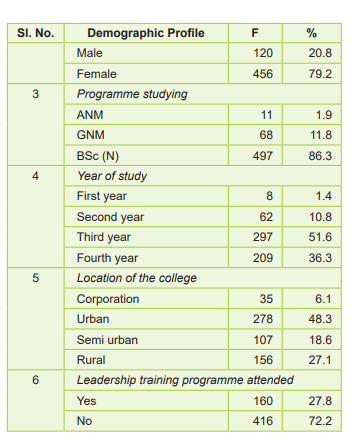
Majority [356 (61.8%)] of the participants were in the age group of 20 years and above and 147 (25.5%) students were in the age group of 19 years (Table 1). Over three-fourth i.e. 456 (79.2%) of them were female and 497 (86,3%) students were pursuing BSc(N) programme. Over half (n=297, 51.6%) were third year students and 209 (36.3%) in final year. Only 27.8 percent of the students had attended leadership training programme.
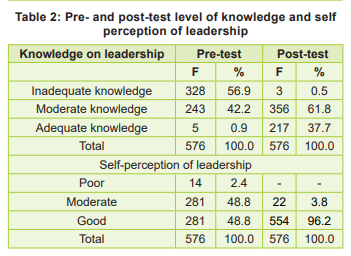
Table 2 shows that 328 (56.9%) students had inadequate knowledge and 243 (42.2%) had moderately adequate knowledge in pre-test, whereas 217 (37.7%) students had adequate knowledge and 356 (61.8%) had moderately adequate knowledge in post-test. With regard to self-perception of leadership, equal percentage of participants 281 (48.8%) had moderate and good perception in pre-test whereas 554 (96.2%) participants had good perception of leadership in post-test.
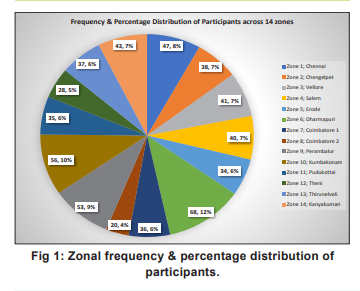
Fig 1 shows the students participation across 14 zones. The percentage of participants had ranged from 4 percent to a maximum of 12 percent.
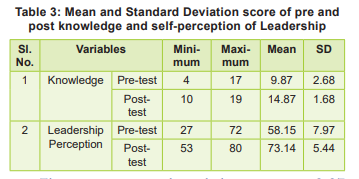
The mean pre-test knowledge score was 9.87 with the SD of 2.68 whereas the post-test mean score was 14.87 with the SD of 1.68 (Table 3). The pre-test mean leadership self-perception score was 27 with the SD of 7.97 whereas the post-test mean score was 73.14 with the SD of 5.44.
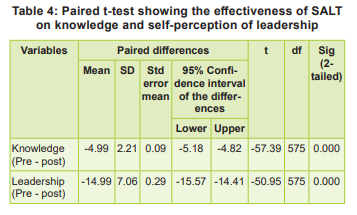
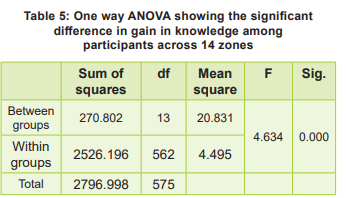
Table 5 examined whether the change in knowledge score differed significantly across 14 zones. There was a statistically significant difference in the knowledge gain among 14 zones at 0.001 level. This means the training programme improved knowledge in all zones. A post hoc analysis (Tukey and Bonferroni) was done to identify which zone significantly performed better. Zone-10 (Kumbakonam) stood out consistently and showed highest improvement in knowledge among all zones.
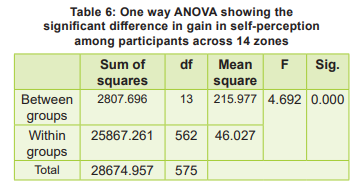
Table 6 showed a statistically significant difference in the self-perception gain among 14 zones at 0.001 level. A post hoc analysis (Tukey and Bonferroni) was done to identify which zone significantly performed better. Though the training programme improved leadership self-perception in all zones but the extent of improvement varied significantly between zones.
Zone-8 (Coimbatore 2) showed a greater improvement in leadership selfperception when compared to other zones.
Association between pre-test level of knowledge and demographic variables of the participants: There was a statistically significant association found between level of knowledge with the programme of study (p<0.05), location of the college (p< 0.01) and having attended leadership training programme (p=0.01)
Association between pre-test level of leadership perception and demographic variables of the participants: There was a statistically significant association found between level of leadership perception with the programme of study (p<0.05) and having attended leadership training programme (p<0.05).
Discussion
In this outcome analysis, majority of the participants were aged 20 years and above, female, studying final and pre-final years, and pursuing BSc(N) programme. Only 27.8 percent of them had attended leadership training programme.
SALT was effective in improving knowledge and leadership self-perception among participants. This programme not only improved knowledge about leadership but increased their confidence in becoming a leader. This result is supported by the blooms taxonomy concept that any changes in affective domain is feasible with the changes in the cognitive domain (12). These findings are supported by Fonseca et al (2025) who reported improvement in self-identification as a leader from 42.86 percent in the pre-test to 57.14 percent in the post-test.
Paired t-test and one-way analysis showed that the SALT programme was effective in improving knowledge and self-perception of leadership among participants across 14 zones. This finding was supported by a scoping review which stated a need for organising comprehensive leadership training programme. In addition, it stated the need for training on communication, interpersonal and decision-making skills for nursing students (Abdul-Rahim et al, 2024). Also, strategic leadership training programme is more effective in improving leadership skills among students than the traditional lectures on the topics. SALT enhanced team/group learning, fostered sharing, friendship and aided collaboration among student leaders. This provided the students with an opportunity for self-reflection and helped them understand their strengths and limitations.
As for gender consideration, research among medical professionals reported that male viewed leadership as their legacy and becoming a leader as a part of their journey. Women were either persuaded or pressured to take up leadership roles. It is by chance that women accept the leadership roles. After assuming leadership positions, men wanted to influence, whereas women wanted to bring positive changes rather than influencing. Men are ready to take up risks and move forward even if they failed, whereas women were worried about the extent of the problem and their vulnerability to failure (Hobgood & Draucker, 2022) although nursing is a female-dominated profession, majority of the participants were females (79.2%). It is the need of the hour that nursing students must be given early exposure to be ready to face challenges and take risks.
Researches on students’ reflection on development of leadership skills using student-run teams at clinical area stated that communication, collaboration, delegation and working under time pressure were both challenging and rewarding in development of leadership skills. They expressed the need for further training and practice in clinical areas which again confirmed the learning and training need (Reime et al, 2022; Costa et al, 2025).
This study contributed to the adoption of SALT as a strategy in training nursing students on leadership development reiterating the importance of early exposure and integrating leadership development in nursing curriculum. Systemic reviews analysing intervention strategies to develop leadership skills among nursing students ranged from student-led models to mobile applications to structured courses (Hobgood & Draucker, 2022; Costa et al, 2025). Curriculum embedded training and active learning approach was effective in improving leadership skills among nursing graduates. Though the methodology differs, the concept of leadership development has gained greater importance. SALT as a structured strategy is effective and feasible in bringing its outcome.
One-way ANOVA revealed statistically significant differences in knowledge and leadership self-perception improvement among the 14 zones indicating that the training programme had varying impact across zones. Post hoc Tukey and Bonferroni tests showed that zone10 (Kumbakonam) demonstrated significantly higher knowledge gain than multiple other zones including zone 2 (Chengelpet), zone 4 (Salem), zone-6 (Dharmapuri), zones 7&8 (Coimbatore 1&2), zone 11 (Pudukottai), zone 13 (Tiruneleli) and zone 14 (Kanyakumari) (p < 0.05). Overall, the findings indicate unequal effectiveness of training across zones, with certain zones showing substantially greater knowledge enhancement.
With regard to leadership self-perception, the post hoc analysis showed that zones such as zone 1 (Chennai), zone 3 (Vellore), zone 7 (Coimbatore 1), zone 10 (Kumbakonam), zone 12 (Theni) and zone 14 (Kanyakumari) showed substantially better improvement whereas Zone 8; Coimbatore 2 showed significantly greater leadership improvement.
Nursing Implications & Recommendations
This analysis recommends periodic, strategic leadership development programmes at basic, intermediate and advanced levels for professional advancement, image building and bringing positive changes. SALT is more engaging and facilitates leadership development. In the training programme, the concept of gender differences in emergence of leadership should be addressed to promote positive view of leadership by female nursing students. A long term follow-up study of the participants can be conducted to evaluate retention of knowledge, sustained leadership self-perception, leadership behaviours in their workplace and translation of leadership skills into clinical and professional practice. SALT can be expanded to all students in all units and can be integrated into nursing curriculum.
Conclusion
SALT is effective and feasible in improving knowledge and self-perception of leadership among all participants across 14 zones. The primary findings demonstrated that concepts such as communication, team building, time management, attitude and professional etiquette are crucial for leadership development among nursing students.
Acknowledgement
We thank EC members, 14 zonal coordinators and 34 resource speakers for their contribution towards this TNAI Tamilnadu branch funded project. We also acknowledge all participating institutions for deputing unit level student leaders and SNAI advisors in conduct of this project.
1. Health Organization. State of the world’s nursing 2025: Investing in Education, Jobs, Leadership and Service Delivery. WHO, 2025
2. World Health Organization. State of the World’s Nursing 2020: Investing in Education, Jobs and Leadership. Geneva, 2020
3. Mohammadpourhodki R, Nabavi FH. A systematic review of interventions aiming to promote leadership skills among nursing students: From in-class strategies to curriculum revisions. Journal of Advances in Medical Education and Professionalism (Shiraz University of Medical Sciences) 2025; 13(2): 83-92
4. Abdul-Rahim HZ, Sharbini SH, Ali M, Hashim SH, Abdul-Mumin KH. Leadership and management skills for student nurses: A scoping review. BMC Nurs 2025 Dec 1; 24(1): 1-14
5. Hsieh LW, Chang YC, Yen M. Improving leadership competence among undergraduate nursing students: Innovative objectives development, implementation, and evaluation. Nurs Educ Perspect 2022; 43(1): 24-29
6. Fonseca JF da, Silva MCB da, Pereira V dos SL, Silva GPD da, Duarte FH da S, Duarte FH da S, et al. Effect of an online module on leadership on the knowledge acquisition of Nursing Students: A pilot randomized clinical trial study. J Nurs Manag 2025; 3769545. doi: 10.1155/jonm/3769545
7. Hu S, Chen W, Satamo M, Löyttyniemi E, Yang M, Liu G, et al. Online training to improve evidence-based leadership competencies among nurse leaders in China: A feasibility randomised controlled trial. BMJ Open 2024 Nov 7; 14 (11). doi: 10.1136/bmjopen-2024-088386
8. Hashish EAA, Bajbeir EF. The effect of managerial and leadership training and simulation on senior nursing students’ career planning and self-efficacy. SAGE Open Nurs 2022; 8: 1-13
9. Labrague LJ. Use of simulation in teaching nursing leadership and management course. Sultan Qaboos University 2021; 21(3): 344–53
10. Alilyyani B, Althobaiti E, Al-Talhi M, Almalki T, Alharthy T, Alnefaie M, et al. Nursing experience and leadership skills among staff nurses and intern nursing students in Saudi Arabia: A mixed methods study. BMC Nurs 2024 Dec 1; 23(1). doi: 10.1177/23779608221127952. eCollection 2022 Jan-Dec
11. Hobgood C, Draucker C. Gender differences in experiences of leadership emergence among emergency medicine department chairs. JAMA Netw Open 2022 Mar 10; 5(3): e221860. doi:10.1001/jamanetworkopen.2022.1860
14. Reime MH, Bell K, Albrigtsen B, Beisland EG. Baccalaureate nursing students’ reflections on professional development within the nursing leadership role when participating in studentrun teams: A qualitative content analysis of student’s reflection notes. SAGE Open Nurs 2022; 8: 1-11
15. Costa P, Sousa JP, Nascimento T, Cruchinho P, Nunes E, Gaspar F, et al. Leadership development in undergraduate nursing students: A scoping review. Nursing reports. Multidisciplinary Digital Publishing Institute (MDPI) 2025; 15(5): 160

This work is licensed under a Creative Commons Attribution-NonCommercial-ShareAlike 4.0 International License.