
Mental health is a fundamental aspect of overall health, yet it frequently receives less focus than physical health, especially in resource-limited settings. In Odisha, challenges in mental health care are exacerbated by a shortage of qualified professionals, limited resources, and socio-cultural obstacles. The role of nurses in patient care, rehabilitation, public health, and primary care is well established (World Health Organization, 2012). However, only 10 percent of those in need of mental health treatment actually receive it (Mitchell et al, 2021). Inadequacy of mental health professionals creates a significant barrier to accessing treatment. WHO estimates that low- and middle-income countries need an additional 1.18 million mental health workers to close this gap. In India, mental health services are further constrained by limited budgets, with only 0.8 percent of mental health nurses per 100,000 people, 0.301 psychiatrists, 0.166 nurses, 0.047 psychologists, and 0.033 mental health social workers per 100,000 people.
In Odisha, there are only 50 mental health professionals across public and private sectors. Enhancing the training of nurses and developing supportive policies are crucial for improving mental health care delivery (Fulton et al, 2011). Recent initiatives like Odisha's District Mental Health Programme (DMHP) and the Mental Health Institute at SCB Medical College have aimed to bolster services through nurse-led screenings and teleconsultations; however, implementation gaps persist due to inadequate integration of mental health modules in community nursing curricula. Nurses are pivotal in bridging this divide, yet they face barriers such as stigma and limited postgraduate training opportunities in psychiatric nursing (Jena et al, 2020; Rehm et al, 2019). A targeted gap analysis is imperative to align educational standards with service demands, fostering evidence-based enhancements in community mental health delivery. And qualitatively, explored challenges in service delivery. A gap analysis can identify differences between mental health education and practice. This shall help healthcare providers and policymakers address these discrepancies and in bridging the gap between theoretical knowledge and practical application.
Literature Review
In India, mental health disorders impact approximately 197.3 million individuals, but funding for mental health services remains insufficient (Sagar R, et al, 2020, Kandeger et al, 2018). In Odisha, depression and anxiety are notably prevalent, especially in regions with lower socio-economic status. WHO (2017) suggests including early identification, management of stable psychiatric conditions, referrals, and preventive services in primary care can reduce treatment gap.
Qualified primary healthcare providers, including nurses with varying levels of training (ANM, GNM, BSc, and MSc Nursing) play a vital role in improving mental health nursing practices and guiding healthcare providers in addressing these gaps (American Nurses Credentialing Centre et al, 2015; Keating, 2011). Addressing the theorypractice gap is essential for meeting the evolving mental health needs. Risjord (2010) noted that this gap occurs when theoretical knowledge is not applied effectively in practice, often exacerbated by heavy workloads. Improving undergraduate education and creating ideal clinical environments can help bridge this gap (Abu Salah A et al, 2018; Risjord, 2010).
In Odisha, the Department of Health Services is training medical officers and establishing a virtual knowledge network for counselling and early screening, and connecting doctors from SCB with specialists from NIMHANS. Mental health programme has been introduced in 30 districts, with 75 staff members working in 23 districts to address the shortage of mental health professionals (Nayak, 2020)
Justification of the study: Nurses, often the first point of contact in PHC, have a vital role in addressing community mental health needs. This study aims to identify knowledge and training gaps among nurses, particularly in rural areas, and explore the challenges and strategies needed to strengthen mental health services through improved training, educational resources, and integration of mental health into primary care.
Objectives
The study endeavoured: (1) to assess the mental health services expected to be provided by nurses in the community with reference to existing community mental health nursing syllabus, and (2) explore the problem identified by the nursing health personnel during delivery of mental health services in Odisha.
Methodology
A mixed method research approach using a convergent parallel research design was adapted in this study. A total 200 Nursing personnel including Nursing Officers & CHO, were selected using multi stage sampling strategy from four selected districts of East Odisha. Part-time research assistants were selected from each four districts who were working as CHO/Nursing Officer.
Tool & Technique:
After receiving the ethical approval from the institutional ethical committee, permission was taken from Ayushman Bharat Health & Wellness Centre (AB HWC-PHC, AB HWC subcentre, AB HWC CHC, district hospital) from four districts of Odisha i.e. Kendrapada, Jagatsingpur, Khordha and Cuttack. The quantitative data were collected using a selfstructured questionnaire. The tool consists of four sections: Section I consists of socio demographic data with 7 items; Section II having 29 selfstructured questionnaires regarding mental health knowledge as per INC syllabus; Section III consisting of 13 items in the form of rating scale to assess nursing services. Each participant took about 30 minutes to mark their responses. The data were analysed by using descriptive & inferential statistics.
Section IV was an open-ended questionnaire to assess the challenges and problems faced by the study participants during service delivery. Data was collected through interview technique from 20 participants till the data saturation. Each interview took 45 minutes; any of the interviews were not repeated. The interviews were transcribed verbatim. The data was then coded. The transcripts were interpreted by each author. The themes were generated by utilising the developed codes. The themes & sub-themes raised from interview were compiled and analysed.
Sampling method: Total 200 numbers of Trained Manpower (Sister incharges-2, CHO-171, Nursing Officers-27) at the Services from the 4 East Zone were selected as per the convenience method, from centres – DHH, CHC, PHC, SC: Kendrapada district (49 nos.), Cuttack district (54 nos.), Khordha district (45 nos.) and Jagatsingpur district (52 nos.).
Results
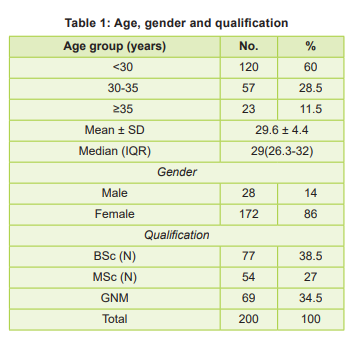
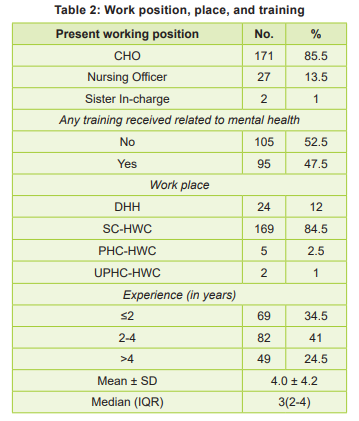
The demographic distribution of the subjects like age group, gender, work position, training, and experience is shown in Tables 1 & 2.
Mental health knowledge & practice scores with Wilcoxon-signed scores and comparison of mental health nursing knowledge and practice
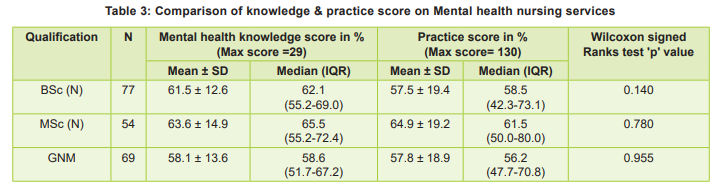
scores among participants with different nursing qualifications are in Tables 3 & 4.
Table 3 presents the comparison of mental health nursing knowledge and practice scores among participants with different nursing qualifications, namely BSc Nursing, MSc Nursing, and GNM. Descriptive statistics are expressed as mean ± standard deviation (SD) and median with interquartile range (IQR). The Wilcoxon Signed Ranks test was applied to examine the difference between knowledge and practice scores within each qualification group, as the data did not meet normality assumptions.
Among BSc Nursing participants (N = 77), the mean knowledge score was 61.5% ± 12.6, while the mean practice score was 57.5% ± 19.4. The median scores also showed comparable distributions for knowledge [62.1 (55.2–69.0)] and practice [58.5 (42.3–73.1)]. The Wilcoxon test revealed no statistically significant difference between knowledge and practice scores (p = 0.140).
For MSc Nursing participants (N = 54), the mean knowledge score (63.6% ± 14.9) was slightly higher than the mean practice score (64.9% ± 19.2). Median values similarly reflected overlapping distributions. The difference between knowledge and practice scores was not statistically significant (p = 0.780).
Among GNM participants (N = 69), the mean knowledge score was 58.1% ± 13.6, and the mean practice score was 57.8% ± 18.9, with closely aligned median values. The Wilcoxon Signed Ranks test indicated no significant difference between knowledge and practice scores (p = 0.955). Overall, the findings suggest that across all qualification groups, knowledge and practice scores on mental health nursing services were comparable, with no statistically significant intra-group differences.
Distribution of Knowledge and Practice Levels on Mental Health Nursing services with Qualification
The categorical distribution of participants’ knowledge and practice levels on mental health nursing services was classified as very poor (≤40),
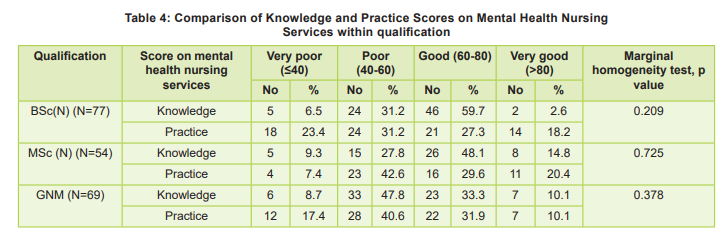
poor (40–60), good (60–80), and very good (>80). The Marginal Homogeneity Test was employed to assess differences between paired categorical distributions of knowledge and practice within each qualification group. Among BSc Nursing participants (N = 77), the majority demonstrated good knowledge (59.7%), whereas practice scores were more evenly distributed, with higher proportions in poor (31.2%) and good (27.3%) categories (Table 4). The marginal homogeneity test showed no statistically significant difference between knowledge and practice category distributions (p = 0.209).
In the MSc Nursing group (N = 54), nearly half of the participants exhibited good knowledge (48.1%), followed by very good knowledge (14.8%). Practice scores were predominantly in the poor (42.6%) and good (29.6%) categories. However, the difference between knowledge and practice distributions was not statistically significant (p = 0.725). For GNM participants (N = 69), most respondents fell under the poor (47.8%) and good (33.3%) knowledge categories, while practice scores showed a similar pattern. The marginal homogeneity test again indicated no significant difference between knowledge and practice levels (p = 0.378).
Although variations were observed in the distribution of knowledge and practice categories across qualification groups, no statistically significant differences were found between knowledge and practice levels within any qualification. This suggests a consistent alignment between knowledge and reported practice of mental health nursing services among nursing professionals.
Qualitative Data Analysis (verbatims are in italic)
Theme 1: Service Delivery and Roles
The qualitative analysis explored the specific roles and experiences of 20 nursing health personnel:
Sub-Theme - Primary Roles: Nurses identified their roles as history taking, conducting mental status examinations, administering medication, and providing counselling.
“The first role is to identify the mentally ill person from the community reach near them, assess the level of affect, counselling required contact with the psychiatrist doctor through Teleconsultation for start treatment and follow up regularly” [sample no. 7]
Sub-Theme - Community Services provided by them: They are also engaged in communitylevel tasks such as screening, organising mental health camps, and facilitating tele-consultations (e-Sanjeevani).
“As a Community Health Officer I'm organising mental health camps at my sub-centre, collecting history and assessing mental patients, doing counselling to the patient and their family members, doing e-Sanjeevani for the patients who needs more specialized care and giving medications as per prescription” [sample no. 2]
Sub - Theme - Handling Common Conditions: The most frequently treated illnesses included Schizophrenia, mania, depression, and OCD, MR etc.
“Actually, we are getting different disorders like MR, OCD, mania, depression, delirium, alcohol use, schizophrenia” [sample no. 1-20]
Theme 2: Challenges Faced related to Patient and Community
Sub-Theme - Stigma and Reluctance: Patients are often reluctant to take medication due to the stigma surrounding mental illness.
“For stigma towards mental illness mostly we are facing problem to make them to understand to continue medication and review as per advice” [sample no. 12]
Sub-Theme-Safety Concerns: Managing psychiatric emergencies, where patients may harm themselves or others, was noted as a significant challenge that disrupts general ward care.
“There are patients those are unpredictively violent either towards self, family or others, it can’t be predicted when they will behave like this” [sample no. 12, 15]
Sub-Theme - Lack of Support: A lack of community participation and interest makes conducting awareness programs difficult.
“As most of the Community people are daily wedger, hence they are not interested to take participate in the programme due to loss of their wedges” [sample no. 3, 17]
Theme 3: Infrastructure and System Issues:
Sub-Theme - Connectivity: Lack of proper network connectivity was a major barrier for teleconsultation services.
“Yes, most of the time it is showing busy and not connecting due to network issue or showing line busy. so, Patient has to wait more than their usual time” [sample no. 5, 7, 20]
“Yes. It is difficult to make the patient sit and wait for video call as they are not comfortable with this and it also time taking to connect with the Hub” [sample no. 8, 11, 17]
Sub-Theme - Resource Gaps: There is a stated need for more resources and improved support systems for patients to ensure treatment adherence.
“We are facing Common problems like lack of knowledge, time, limited logistics” [sample no. 15] “Lack of resources” [sample no. 9]
To sum up, the Nursing Officers should maximise their clinical roles such as screening, organising mental health camps, and facilitating tele-consultations (e-Sanjeevani). Specific clinical skills like IPR maintenance and Milieu therapy should be planned out for the Nursing Officers/ CHO.
Overall synthesis of quantitative and qualitative findings indicates a significant gap between the high theoretical knowledge of nursing personnel and the practical application of those skills in clinical settings. While a majority of the staff possess good knowledge, nearly half struggle with consistent clinical practice. The quantitative data highlights a disparity between what nursing personnel know and how they perform as 56 percent nursing personnel demonstrated "good" or "very good" levels of mental health knowledge. The remaining 44 percent had knowledge gap on mental health. At practice level, only 45.5 percent achieved "good" or "very good" scores in actual practice; 17 percent fell into the "very poor" category and 37.5 percent into poor category. Practice scores significantly improved with years of experience (p=0.015), suggesting that seniority leads to better clinical application of mental health nursing skills. As for training deficit, 52.5 percent of the nursing personnel had not received specific training related to mental health.
Discussion
Our study found a moderate level of community mental health knowledge among participants, with a mean score of 60.9 percent. Similar findings were reported in Karnataka, where most nurses under the District Community Mental Health Programme demonstrated good knowledge of risk factors for mental illness (Gandhi et al, 2019). Studies from Nepal and Nigeria also reported satisfactory awareness among nurses regarding causes and management of mental illness (Mariam MG, Bedaso A; Ayano G et al, 2016; Li et al, 2022). However, evidence from Ethiopia showed comparatively lower levels, with only 44.2 percent demonstrating adequate knowledge and a favourable attitude (Bing et al, 2018).
Educational qualification appeared to influence knowledge. Participants with an MSc Nursing achieved a higher mean knowledge score (63.6%) than BSc Nursing and GNM participants. This is consistent with studies from China and Karnataka, which reported better mental health knowledge among nurses with higher education (Li et al, 2022; 2022). Training in mental health was also associated with better performance. Participants who had received mental health training obtained higher practice scores (63.1%) than those without training (56.5%). Previous studies have demonstrated that structured inservice and community mental health training can improve nurses’ knowledge, confidence, and clinical performance (Atashzadeh-Shoorideh et al, 2018). Similarly, participants with an MSc Nursing showed better practice scores (64.9%), supporting evidence that specialised education enhances clinical competency (Abbaspour et al, 2021).
Participants with more than four years of experience had a higher mean practice score (66.2%), although this differs from findings in Iran, where experience was not significantly associated with clinical competency (Duran Gul & Akp?nar, 2023). Despite moderate knowledge, participants demonstrated poor to very poor practice scores, indicating a gap between theoretical knowledge and its application. Similar barriers include difficulty translating theory into practice, inadequate clinical exposure, unclear professional roles, communication difficulties, stigma, and limited expertise (Li et al, 2022).
Key community mental health responsibilities include history taking, mental status examination, medication administration, and counselling, consistent with evidence from Saudi Arabia (Alzahrani, 2023). Major challenges included medication non-adherence, managing violent patients, and limited acceptance of mental illness by patients and families. Comparable challenges include violence, stigma, staff shortages, inadequate infrastructure, and medication shortages.
Limitation: The study was limited to only four districts of East Odisha due to financial constraints.
Recommendation: Future studies could include a larger sample size along with the inclusion of more districts for increasing generalisability.
Conclusion
The gap between the knowledge and actual practice of community mental health services among nursing personnel was relatively small, as most nurses had good knowledge and were able to provide appropriate mental health care. However, they still faced challenges, including patients’ reluctance to take medications regularly, difficulty managing violent patients, and limited acceptance of mental illness among patients and their family members. To overcome these, regular in-service education and training programmes are suggested for nurses to strengthen their knowledge and skills, to ensure that patients with mental health problems receive timely and effective care.
1. World Health Organization (WHO). WHO Guideline on Health Policy and System Support to Optimize Community Health Worker Selected Highlights [Internet] 2012. Available from: https://apps.who.int/iris/bitstream/handle/10665/275501/WHOHIS-HWF-CHW-2018.1-eng.pdf?ua=1
2. Mitchell C. Mental health problems are the leading cause of disability worldwide, say experts at PAHO Directing Council side event [Internet]. Pan American Health Organization / World Health Organization 2019 [cited 2021 Dec 25]
3. Fulton BD, Scheffler RM, Sparkes SP, Auh EY, Vujicic M, Soucat A. Health workforce skill mix and task shifting in low income countries: A review of recent evidence. Hum Resour Health 2011; 9: 1. doi: 10.1186/1478-4491-9-1
4. Jena S, Sahoo KC, Samal M, Kripalini P, Shrivastava Chandni, Anand Henanee, et al. Rural community attitude towards mental healthcare: A mixed-method study in Khurda district of Odisha, India. Middle East Curr Psychiatry 2020; 27 (1): 1-8. https://doi.org/10.1186/s43045-020-00057-6
5. Rehm J, Shield KD. Global burden of disease and the impact of mental and addictive disorders. Current Psychiatry Reports 2019; 21: 10. https://doi.org/10.1007/s11920-019-0997-0
6. Sagar R, Dandona R, Gururaj G, Dhaliwal RS, Singh A, Ferrari A, et al The burden of mental disorders across the states of India: The Global Burden of Disease Study 1990–2017. Lancet Psychiatry 2020; 7(2): 148–61. https://doi.org/10.1016/S2215- 0366(19)30475-4
7. Kandeger A, Guler HA, Egilmez U, Guler O. Major depressive disorder comorbid severe hydrocephalus caused by Arnold - Chiari malformation. Does exposure to a seclusion and restraint event during clerkship influence medical student’s attitudes toward psychiatry. Indian J Psychiatry 2018; 59(4): 520-21
8. Keating S. Curriculum Development and Evaluation in Nursing. Springer Publishing Company New York, NY: 2011
9. Abu Salah A, Aljerjawy M, Salama A. Gap between theory and practice in the nursing education: The role of clinical setting. JOJ Nurse Health Care 2018; 7(2): 555707
10. Risjord Mark. Nursing Knowledge: Science, Practice and Philosophy. January 2010. Oxford: Wiley Blackwell. ISBN 978- 14051-8434-2
11. Nayak N. Mental Health Services Spreads Wings in Odisha. Odisha Post, 7 January 2020. https://www.orissapost.com/ mental-health-services-spread-wings-in-odisha/
12. Gandhi, S, Poreddi V, Govindan R, Gurusamy J, Anjanappa S, Sahu M, et al. Knowledge and perceptions of Indian primary care nurses towards mental illness. Investigacion y EDUCATION EN en Enfermeria 2019; 37(1), eo6. https://doi. org/10.17533/udea.iee.v37n1a06
13. Mariam MG, Bedaso A, Ayano G, Ebrahim J. Knowledge, attitude and factors associated with mental illness among nurses working in public hospitals, Addis Ababa, Ethiopia. J Ment Disord Treat 2016; 2(1); 108. doi:10.4172/2471- 271X.1000108
14. Bing XY, Stone TE, Davis SA. The effect of a community mental health training program for multidisciplinary staff. Archives of Psychiatric 2018; 32(3): 413-17. ISSN 0883-9417, https://doi. org/10.1016/j.apnu.2017.12.007
15. Li C, Yang F, Yang BX, Chen W, Wang Q, Huang H, et al. Experiences and challenges faced by community mental health workers when providing care to people with mental illness: A qualitative study. BMC Psychiatry 2022; 22(1): 623. https://doi. org/10.1186/s12888-022-04252-z
16. Atashzadeh-Shoorideh F, Mohtashami J, Pishgooie SAH, Jamshidi Tayebeh, Sedghi Sara, et al. Effectiveness of implementation of “mental health nursing students’ clinical competency model on academic performance of nursing students. National Library of Medicine 2018; 7 (7): 1212. https://doi.org/10.12688/f1000research.14284.1
17. Abbaspour H, Heydari A, Esmaily H. Study of the relationship between nurses' work experience and clinical competency. Med Edu Bull 2021; 2(1): 155-62
18. Duran Gül K, Akp?nar H. The relationship between nursing students' mental health literacy levels and holistic nursing competencies. J Health Sci Med 2023; 6(6): 1147-53
19. Alzahrani MS. The role of the mental health nurse in the application of different treatment modalities in mental health nursing: Evidence-Based Nursing Research 2023; 5(2): 45-47 https://doi.org/10.47104/ebnrojs3.v5i2.287
20. Zwane PG, Shongwe MC, Shabalala FS. et al. Challenges faced by mental health nurses working with people living with mental illness in Eswatini: A qualitative study Elsevier; 2022 [cited 2024 Sept 2] Available from: https://www.sciencedirect. com/science/article/pii/S2214139122000828

This work is licensed under a Creative Commons Attribution-NonCommercial-ShareAlike 4.0 International License.