
Health is a fundamental human right and the basis for individual, family, and national prosperity. The World Health Organisation defines health as “a state of complete physical, mental and social wellbeing and not merely the absence of disease or infirmity.” The World Health Day 2023 theme, “Saving Lives, Driving Health for All,” emphasises inclusive health, particularly maternal health, which is central to family and community wellbeing. Women, who constitute nearly half the global population (World Data Bank, 2023), play vital roles as caregivers and mothers, making maternal health a public health priority.
Maternal health refers to women’s health during pregnancy, childbirth, and the postpartum period, encompassing family planning, preconception, antenatal, and postnatal care. Universal Health Coverage (UHC), a core Sustainable Development Goal (SDG), calls for equitable access to quality health services without financial hardship. Yet inequities persist: urban, educated, and wealthier populations access services more easily than rural and marginalised groups. Out-of-pocket health expenditure continues to push vulnerable households into poverty, highlighting inequality as a barrier to UHC.
Global maternal health remains a pressing challenge. In 2020, 287,000 women died during or after pregnancy and childbirth, 95 percent of whom were from low- and lower-middle-income countries, largely due to preventable causes. Major direct contributors include hypertensive disorders, haemorrhage, sepsis, unsafe abortions, and obstructed labour, while indirect causes such as anaemia and malaria exacerbate risks. Adolescents are particularly vulnerable, with pregnancy complications being the leading cause of death among girls aged 15-19 years. Skilled care during pregnancy, childbirth, and postpartum is vital to prevent these deaths (WHO, 2020).
The SDG target aims to reduce the global maternal mortality ratio (MMR) to fewer than 70 per 100,000 live births by 2030. WHO, UNICEF, and UNFPA advocate integrated, evidence-based, and people-centred maternal and perinatal services to achieve this goal. Programs like the Maternal Health Unit (MAH) and Monitor strengthen policies, data, and evidence-based practices globally.
India has made significant progress in reducing maternal mortality. The MMR declined from 556 (1990) to 113, a 78 percent reduction, outpacing the global average decline of 45 percent. Institutional deliveries rose from 47 percent (2007-08) to 88.6 percent (NFHS-5, 2019- 21). States like Kerala, Maharashtra, and Tamil Nadu have already met SDG targets. National programmes such as the Janani Suraksha Yojana (JSY), Janani Shishu Suraksha Karyakram (JSSK), and Pradhan Mantri Surakshit Matritva Abhiyan (PMSMA) have expanded access to institutional deliveries, antenatal screening, and free maternal-child health services. However, gaps in awareness, accessibility, and equity persist, particularly among rural, lowincome, and marginalised women and maternal mortality remains unacceptably high due to delays in seeking, reaching, and receiving care. Strengthening utilisation of maternal healthcare services, with a focus on awareness, equity, and quality, is crucial and the need of this hour. This study was conducted to assess women’s knowledge and use of existing maternal health services that help to identify barriers and inform strategies to improve outcomes.
Need for the study: Maternal health is an essential component of national health and a critical indicator of social progress. Despite global and national efforts to reduce maternal mortality and improve maternal outcomes, disparities persist in the utilisation of maternal health care (MHC) services, particularly in low- and middle-income countries. The World Health Organisation (2020) estimates that approximately 287,000 women die annually from preventable maternal causes, with 95 percent of deaths occurring in developing countries. India, though showing remarkable progress, still faces regional inequities, with variations in service uptake between urban and rural areas.
Tamil Nadu, a progressive state in maternal health, has achieved near-SDG targets; however, localised assessments reveal gaps in the consistent utilisation of antenatal, intranatal, and post-natal care services among certain subgroups of women (NFHS-5, 2019-21). Studies indicate that factors such as socioeconomic status, education, awareness, and accessibility significantly influence service utilisation (Paul & Chouhan, 2020). Given that nurses form the cornerstone of maternal and community health service delivery, understanding the level of utilisation and factors influencing it is crucial to guide future interventions. This study undertook to assess the utilisation of maternal health care services among married women in a selected community in Tamil Nadu, thereby identifying the existing strengths and service gaps to guide nursing practice and policy.
Objectives
The study was set out (i) to assess the utilisation of maternal health care services among married women in Chennai, and (ii) to determine the association between the selected demographic variables and the utilisation of maternal health care services among married women.
Review of Literature Lee et all (2024), in a study on trends in ANC quality across India reported state-wise heterogeneity and identified that while service contact increased nationally, quality indicators improved unevenly. The authors argued for targeted interventions in states/districts with low content scores, and called for routine facility and community-level quality audits, data-driven supervisory systems, and strengthening of frontline health cadres such as nurses and ANMs.
Using NFHS-5 data, Girotra et al (2023) assessed the adequacy and quality of antenatal care services in India, and revealed that while overall coverage was high, only 59 percent of women received at least four ANC visits. Socioeconomic disparities remained significant. The study suggested strengthening communitybased maternal health promotion and periodic evaluations to ensure quality care, particularly through nurse-led follow-up systems.
In a cross-sectional study on Respectful Maternity Care (RMC) practices among nurses in Tamil Nadu, the researchers found that nurses’ knowledge and practice of RMC significantly improved maternal satisfaction and trust in institutional services. The study reinforced the importance of nurse-led interventions that ensure dignity, empathy, and safety during childbirth— factors that indirectly enhance maternal service utilisation (Pandiselvi et al, 2024).
An analysis of young married women aged 15-24 years across India (NFHS 1992-2016) by Singh et al (2021) revealed an upward trend in institutional deliveries and ANC attendance; however, disparities persisted by income and education level. The study recommended targetted interventions for socioeconomically disadvantaged groups, underscoring the need for tailored nursing outreach and health literacy programmes. Paul & Chouhan (2020) explored socio-demographic determinants of maternal health service utilisation across 29 Indian states. Women’s education, parity, caste, and urban residence were found to be significant predictors of maternal health service utilisation. The authors highlighted the need for decentralised, community-based maternal care programmes that bridge rural-urban gaps through nurse-led initiatives.
Methods
The present study employed a correlational research design to explore the relationships between socio-demographic characteristics, health variables, and the utilisation of maternal health care services. The study population consisted of married women aged 18 to 40 years having at least one living child, residing in Melayanambakkam village, Chennai. A total of 130 such women were included in the sample. The researcher used a consecutive sampling strategy: that is, women who met the inclusion criteria and were accessible during the data collection period were approached in sequence, until the target sample size of 130 was reached. Sample size was estimated based on the previous study report where 59 percent of women reported ≥ 4 ANC visits during their last pregnancy (Girotra et al, 2023), using the formulae 4pq/d2 (p=59%, d=15%). Hence the required sample size was 123, which was rounded up to 130.
Data collection was carried out over a period of four weeks after obtaining ethical clearance from, IEC of Apollo College of Nursing, Chennai. Face-to-face interviews were conducted using structured instruments. Data was collected using pre-tested and validated tools developed by the researchers based on the literate review, experts’ opinion and their experience in the field. Three tools were used: a socio-demographic proforma to gather background information about the women (such as age, education, occupation, age at marriage, parity, family income, etc.); a health variables proforma to capture health status and history (for example previous pregnancies, any chronic illnesses, obstetric history, past complications, etc.); and a utilisation checklist that recorded the extent to which maternal health care services were used (antenatal care visits, place of delivery, post-natal check-ups, tetanus immunisation, uptake of iron/folic acid, etc).
Results
The collected data were coded, entered into a master coding sheet, and analysed according to the study objectives and hypotheses. Descriptive statistics such as frequency, percentage, mean, and standard deviation were used to summarise socio-demographic characteristics, health variables, and the level of utilisation of maternal health care services. The overall utilisation scores were described in terms of mean, percentage mean, and variability. Inferential statistics, including chi-square test, were applied to determine the association between selected socio-demographic variables and the utilisation of maternal health care services. A p-value of <0.05 was considered statistically significant for all analyses.
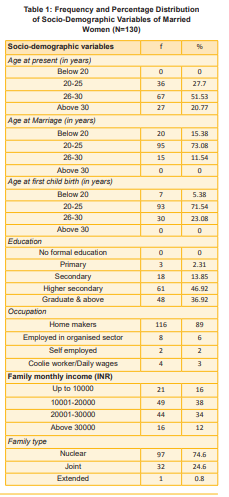
Table 1 depicts that more than half of women (51.53%) were aged 26-30 years. Majority of them were married between 20-25 years (73.08%), and had their first child when they were 20-25 years old (71.54%), homemakers (89%), from nuclear family (74.6%). Nearly half of the mothers had
completed higher secondary education (46.9%), and their family monthly income was between 10,001-20,000 INR per month (38%). The mean score of utilisation of maternal health care services is 22.38 with mean % of 89.52 and SD 3.0 (Table 2).
Table 3 reveals that there is no association between the selected demographic variables and the utilisation of utilisation of maternal health care services. So, the hypothesis “There will be significant association between selected
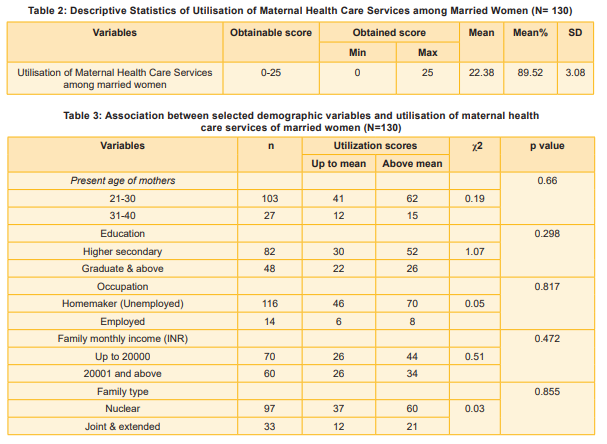
Demographic Variables and Utilisation of Maternal Health Care Services” is rejected.
Discussion
The present study revealed a high level of utilisation of maternal health care services among married women in Melayanambakkam, Chennai, with a mean utilisation score of 22.38 out of 25 (89.52%). Almost all participants were registered in the first trimester and availed antenatal, intranasal, and post-natal services, reflecting the effectiveness of government health initiatives in Tamil Nadu. These findings are consistent with earlier reports of improved institutional deliveries and maternal service coverage at the national level (Singh et al, 2021).
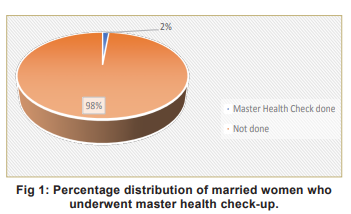
However, despite overall high utilisation, certain preventive aspects such as master health check-ups and health insurance coverage were underutilised. Barriers to complete maternal health coverage often include gaps in awareness, cultural beliefs, and accessibility issues, as highlighted by Ogbo et al (2019). This indicates the need for continuous efforts to address inequities in service utilisation, particularly among underserved women.
Our study found no significant association between socio-demographic variables and utilisation. In contrast, large-scale studies in India have demonstrated that education, age, wealth, and place of residence are strong predictors of maternal service use (Paul & Chouhan, 2020). The difference may be attributed to the relatively homogenous socio-demographic background of our sample and the strong community-level interventions in Tamil Nadu.
Studies conducted by Vijayalakshmi et al (2021) and Sathya et al (2021) emphasised that mothers’ knowledge and utilisation of child immunisation services in Chennai are essential components of the country’s health care system. Overall, the findings of both the previous and present studies reflect an improvement in the utilisation of health care services, which is a positive and encouraging trend.
Nursing professionals play a vital role in strengthening maternal health outcomes. Evidence suggests that respectful maternity care practices improve women’s trust and willingness to use health services (Pandiselvi, et al 2024; 2024b). The high awareness (99%) observed in our study may be the result of consistent nurseled health education and community engagement. Respectful and supportive care also aligns with the global emphasis on patient-centred health services, which is critical to achieving universal health coverage. Further, maternal mental health is an emerging concern. Priya et al (2017) demonstrated the impact of postpartum depression risk factor. Linking maternal service utilisation with psychological support is therefore crucial. Nurses, by virtue of their close interaction with women during antenatal and post-natal periods, are well-positioned to identify and intervene early in maternal mental health concerns. Further, their help seeking and utilisation may be influenced by their beliefs on health and other socio demographic factors (Vijayalakshmi, 2021).
The present study highlights a commendably high level of maternal health service utilisation among married women in Melayanambakkam, Chennai, reflecting the success of sustained government efforts and nurse-led community initiatives in Tamil Nadu. While antenatal, intranatal, and post-natal care services were extensively utilised, underutilisation of preventive services such as master health check-ups and health insurance points to persistent gaps that warrant attention. The absence of significant associations between socio-demographic factors and service utilisation suggests that equitable access has largely been achieved within the study population, likely due to effective communitybased interventions.
Nursing Implications
Nursing practice: Community health nurses should provide targeted health education, promote early registration, complete antenatal care, institutional deliveries, and postnatal follow-up. Home visits and respectful, empathetic care can identify high-risk mothers and encourage service utilisation.
Nursing education: Nursing curricula should include maternal service utilisation, social determinants, and behavioural aspects. Training in community engagement, culturally sensitive communication, and family-centred counselling can enhance service acceptance. Nursing administration:
Nurse administrators should coordinate community outreach, link PHCs with referral hospitals through nurse-led continuity-of-care models, and monitor maternal service delivery for efficiency and accountability.
Nursing research: Future studies should explore psychosocial and familial barriers, evaluate nurse-led interventions, and compare urbanrural disparities to inform targetted strategies.
Policy issues: Findings can guide policymakers to strengthen nurse-led maternal and child health programs, supporting SDG targets for maternal mortality reduction and improving service access, quality, and continuity.
Recommendations
Conclusion
The study revealed that most of the married women utilised the maternal health care services provided by the government of India and the State, which is encouraging, and reflects the success of government health promotion implementation in Tamil Nadu. Though a minimum percentage of mothers did not utilise the services, which cannot be taken lightly since the Sustainable Development Goals by 2030 must target the MMR to be reduced to 70. Therefore, health care professionals including nurses play vital role in motivating the mothers to utilise maternal health care services to achieve goals of SDG-2030.
1. Girotra S, Malik M, Roy S, Basu S. Utilization and determinants of adequate quality antenatal care services in India: Evidence from the National Family Health Survey (NFHS-5) (2019-21). BMC Pregnancy Childbirth 2023; (23): 800. https://doi.org/10.1186/s12884-023-06117-z
2. Global maternal health remains a pressing challenge – 2020 statistics. World Health Organization 2020. https:// dev-cms.who.int/news-room/fact-sheets/detail/maternalmortality
3. Janani Suraksha Yojana (JSY), Janani Shishu Suraksha Karyakram (JSSK), and Pradhan Mantri Surakshit Matritva Abhiyan (PMSMA) – Central Government Health Schemes (2023). https://www.frontiersin.org/ researchtopics/55711/world-health-day-2023-progressand-new-perspectives-in-achievements (Accessed April 23, 2024)
4. Lee HY, Kumar A, Jain A, Kim R, Subramanian SV. Trends in the quality of antenatal care in India: Patterns of change across 36 states and union territories, 1999- 2021. Journal of Global Health 2024; 14.04188
5. World Health Organization. https://www.who.int/groups/ mother-and-newborn-information-for-tracking-outcomes and-results (Accessed June 18, 2024)
6. Maternal Mortality Rate - Press release: India on track to achieving the Maternal Mortality Ratio (MMR). (2020). Press Information Bureau. https://pib.gov.in/ Pressreleaseshare.aspxPRID=1639376 (Accessed February 7, 2024)
7. Maternal mortality SDG Target 3.1 (n.d.). World Health Organization. https://www.who.int/maternal-mortalitysdg-target (Accessed February 7, 2024)
8. Pandiselvi R, Vijayalakshmi K, Vasantha S. Awareness on respectful maternity care: A cross sectional study among nurses. Research Review International Journal of Multidisciplinary 2024; 9(5): 73-81
9. Pandiselvi, R Vijayalakshmi K, Vasantha S. Respectful maternity care practices during labour among nursing personnel. International Journal of Advance Research, Ideas and Innovations in Technology 2024; 10(3): 92-99
10. Paul P, Chouhan P. Socio-demographic factors influencing utilization of maternal health care services in India. Clinical Epidemiology and Global Health 2020. 8(3): 666-70. https://doi.org/10.1016/j.cegh.2020.01.007
11. Priya S, Venkatesan L, Vijayalakshmi K. Risk Factors of postpartum depression among the postnatal mothers. University Journal of Nursing Sciences 2017; 1(1)
12. Singh P, Singh KK, Singh P. Maternal health care service utilization among young married women in India, 1992–2016: Trends and determinants. BMC Pregnancy and Childbirth 2021; 21(1): 122. https://doi.org/10.1186/ s12884-021-03593-0
13. UNICEF. Maternal & Adolescent Healthcare 2023. https://www.unicef.org/india/what-we-do/maternal-health (Accessed January 15, 2023)
14. Vijayalakshmi K. Help seeking behaviour of mentally ill patients: A cross sectional study. TNNMC Journal of Mental Health Nursing 2021; 9(1): 23-29
15. Vijayalakshmi K, Venkatesan L, Satchi NSR, Christy LG. Study of knowledge of mothers on immunization of children and its associated factors in Chennai, India. International Journal of Advance Research, Ideas and Innovations in Technology (IJARIIT) 2021; 75: 62-65
16. World Health Organization. Maternal health. 2020. https:// www.who.int/health-topics/maternal-health#tab=tab_1
17. Ogbo FA, Dhami MV, Ude EM, Senanayake P, Osuaguru UL, Acuosemo QO el al Enablers and barriers to the utilization of antenatal Care Services in India. International Journal of Environmental Research and Public Health 2019; 169 (7): 3152
18. Sathya N and Latha Venkatesanl Immunization coverage of Children and its assoualed factors in Chennai, India. Journal of Applied Science and Research 2021; 9 (1): 26-35

This work is licensed under a Creative Commons Attribution-NonCommercial-ShareAlike 4.0 International License.