
Snakebite envenomation is recognised by the World Health Organisation as a Neglected Tropical Disease, disproportionately affecting rural and socioeconomically disadvantaged populations. India accounts for nearly half of global snakebite deaths, largely due to delayed healthcare access, harmful traditional practices, and inadequate emergency preparedness.
Despite availability of antivenom, outcomes remain poor, highlighting gaps in early assessment, nursing intervention, community awareness, and education. Nurses serve as frontline healthcare providers in Primary and Community Health Centres, making their role pivotal in reducing mortality related to snakebite.
Objectives
This review was undertaken with the following objectives.
Materials and Methods
Study design:An integrative review methodology was adopted.
Search strategy: Electronic databases PubMed, Google Scholar, Scopus, and CINAHL were searched for articles published between 2010-2024.
Search terms: These included ‘snakebite envenomation,’ ‘nursing management,’ ‘antivenom,’ ‘clinical outcomes,’ ‘India.’
Inclusion criteria: Studies conducted in India; English language; quantitative or qualitative designs; focus on clinical management, nursing care, or prevention.
Exclusion criteria: Case reports; non-peer-reviewed articles; animal studies.
After screening titles, abstracts, and full texts, 12 articles were included (Table 1).
Results
Theme 1: Delayed Hospital Presentation
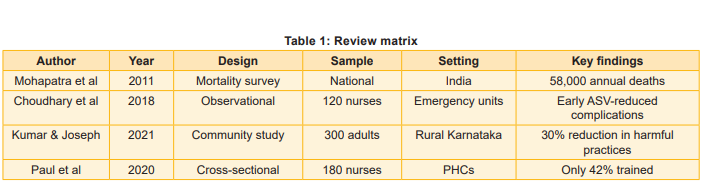
Most victims reached healthcare facilities after 6-12 hours due to reliance on traditional healers.
Theme 2: Limited Nursing Preparedness
Less than half of nurses had formal training in snakebite management.
Theme 3: Effectiveness of Nurse-Led Education
Community awareness programmes significantly reduced harmful first-aid practices.
Theme 4: Clinical Outcomes with Early Intervention Prompt antivenom administration and airway support improved survival.
Discussion
This review highlights snakebite envenomation as both a clinical emergency and public health challenge. Delayed care and lack of trained nursing staff remain key contributors to mortality. Studies consistently demonstrate improved outcomes with early nursing intervention and standardised protocols.
Despite national guidelines, gaps persist in rural preparedness, antivenom access, and continuing education.
Implications
Nursing Practice
Nursing Education
Nursing Research
Policy Level
Limitations
The review included only English-language studies and lacked meta-analysis due to heterogeneity.
Conclusion
Snakebite envenomation remains a preventable cause of death in India. Evidence indicates that trained nurses significantly improve outcomes through early intervention and community education. Strengthening nursing capacity is essential to achieving national and WHO targets.
1. Mohapatra B, Warrell DA, Suraweera W, Bhatia P, Dhingra N, Jotkar RM, et al. Snakebite mortality in India: A nationally representative mortality survey. PLoS Negl Trop Dis 2011; 5(4): e1018
2. World Health Organization. Snakebite Envenoming. Geneva: WHO, 2021
3. Bawaskar HS, Bawaskar PH, Punde DP, Inamdar MK, Dongare RB, Bhoite RR. Clinical profile of snakebite envenomation in rural India. J Assoc Physicians India 2020; 68(3): 11-15
4. Yadav Akanksha, Ghosh Pritam, Bandyopadhyay Lina, Paul Bobby, Ghose Sauryadripta, Dasgupta Aparajita. Readiness of primary healthcare workers in snakebite management: A cross-sectional survey. J Family Med Prim Care 2020; 9(5): 2403-408
5. World Health Organization, Regional Office for South-East Asia. Guidelines for the Management of Snakebites. 2nd edn, New Delhi: WHO SEARO; 2016
6. Ministry of Health and Family Welfare, Government of India. National Standard Treatment Guidelines for Snakebite. New Delhi: MoHFW, 2017
7. World Health Organization. Ending the Neglect to Attain the Sustainable Development Goals: A Roadmap for Neglected Tropical Diseases 2021-2030. Geneva: WHO; 2020
8. Indian Council of Medical Research. National Action Plan for Prevention and Control of Snakebite Envenoming (NAPSE). New Delhi: ICMR, 2024
9. Warrell DA. Guidelines for the Management of snakebites. WHO Regional Publi

This work is licensed under a Creative Commons Attribution-NonCommercial-ShareAlike 4.0 International License.