
The transition from school to college, a critical developmental phase, requires substantial academic, social, and emotional adaptation. In India, nursing students often enter college at a young age and face challenges such as academic rigour, hostel life, separation from family, and early clinical exposure. Recent national reports on student mental health indicate increasing stress, anxiety, and adjustment difficulties among health professional students, emphasising the need for early identification and support. Adjustment to college refers to a student’s ability to adapt academically, socially, personallyemotionally, and institutionally. Poor adjustment during the first year is associated with stress, absenteeism, poor academic performance, and attrition. Coping strategies play a mediating role in managing these stressors and promoting resilience.
Need for the study:
Nursing education entails rigorous coursework, clinical practice, and high emotional involvement. First-year students often face diverse challenges, including adjusting to new teaching methods, managing increased academic demands, adapting to hostel life, and overcoming homesickness. These stressors can adversely affect students’ motivation, attendance, academic performance, and overall well-being. As the class coordinator for the first-year BSc nursing batch, the investigator observed recurring issues among students, such as frequent absenteeism due to sickness, persistent homesickness, lack of interest in studies, classroom sleepiness, and interpersonal complaints. These behavioural and emotional difficulties reflected underlying adjustment problems and inadequate coping strategies. Such concerns, if left unaddressed, may lead to poor academic outcomes, decreased self-esteem, and early attrition from the course.
Therefore, understanding the nature and extent of adjustment difficulties and the coping strategies employed by 1st-year nursing students is essential to designing evidencebased interventions. Insights from this study can guide faculty and administrators in formulating structured mentoring, counselling, and wellness programmes to promote holistic adjustment, resilience, and academic success among nursing students. While previous Indian studies have examined adjustment or coping independently using quantitative approaches, limited research has adopted a mixed-method design to integrate measurable levels of adjustment with students’ lived experience. This study addresses this gap by using a sequential explanatory mixed-method approach to comprehensively assess adjustment and coping among 1st-year BSc Nursing students.
Objectives
Quantitative: To assess the level of adjustment among 1st-year BSc Nursing students; To identify coping strategies adopted by 1st-year BSc Nursing students; To correlate the level of adjustment with the coping strategies adopted by 1st-year BSc Nursing students, and; To find the association between the level of adjustment and coping with selected demographic variables.
Qualitative: To explore the lived experiences of first-year BSc Nursing students in coping with adjustment problems.
Materials and Methods
Research design: A sequential explanatory mixedmethod design was adopted. Quantitative data were collected and analysed first, followed by qualitative data collection to explain and elaborate on quantitative findings.
Setting and participants: The study was conducted in a selected nursing college in Chennai. Participants were 1st-year BSc Nursing students who had completed at least three months after joining the course, ensuring adequate exposure to the college environment.
Sample size and sampling: All eligible first-year students (N = 60) were included in the quantitative phase using total population sampling. For the qualitative phase, nine students with low adjustment and/or coping scores (extreme cases) were selected purposively. Data saturation was achieved with nine interviews. In-depth interviews were continued until data saturation was achieved, that is, no new themes or information emerged from subsequent interviews, which occurred by the ninth interview.
Data Collection Tools
Demographic proforma: Included 12 items related to age, gender, residence, family type, schooling, and parental education.
Student adaptation to college questionnaire (SACQ): A modified version of the SACQ (Baker & Siryk, 1984) consisting of 67 items across four domains: academic, social, personal-emotional, and institutional adjustment.
Scoring: Higher scores indicate better adjustment. Scores were categorised as low, moderate, and high adjustment based on tertile distribution.
Validity and reliability: Content validity was established by experts in nursing and psychology. The reliability coefficient (Cronbach’s alpha) was acceptable (>0.80).
Coping strategies scale: Investigator-developed and expert-validated tool assessing problem-focused, emotion-focused, social support, spiritual/ religious, avoidant, and maladaptive coping. Coping levels were categorised as very poor, needs improvement, adequate, and excellent. As for reliability, Cronbach’s alpha was satisfactory (>0.75). A Qualitative Interview Guide consisted of a semi-structured open-ended questions.
Data Collection Procedure
Students were informed about the study through a Google Form information sheet. Electronic informed consent was obtained before participation. Participation was voluntary, and students were informed of their right to withdraw at any time without academic consequences. Of the students assembled, all 60 consented and participated.
Ethical considerations:
Prior written permission to conduct the study was obtained from the principal of the selected nursing college. The study was noninterventional in nature and involved minimal risk to participants. Since the data were collected as part of an academic research activity among adult students, separate Institutional Ethics Committee approval was not sought. Informed electronic consent was obtained, and confidentiality and anonymity were strictly maintained. The investigator declared her academic role and ensured no coercion in participation.
Data Analysis
Quantitative: Data normality was assessed and found suitable for parametric tests. Descriptive statistics, Pearson correlation, Chi-square test, and repeated measures ANOVA were used.
Qualitative: The principal investigator received formal orientation in qualitative research methods during postgraduate nursing education and followed standard guidelines for conducting indepth interviews. Interviews were conducted using a semi-structured guide, and peer review was employed during data analysis. Colaizzi’s method was followed. Coding was peer-reviewed by a qualitative research expert. Member checking was performed, and translation validity was ensured through back-translation. Data saturation was confirmed when repeated patterns and themes emerged consistently across interviews without the addition of new codes.
Results
Demographic variables of adolescents: The demographic profile of the participants shows that the majority were aged 18 & 19 years (53.3% and 43.3% respectively), highlighting that the sample primarily comprised younger 1st-year students. In terms of state of origin, more students hailed from Tamil Nadu (53.3%) than Kerala (46.7%). The mother tongue distribution reflected similar proportions, with Tamil (51.7%) and Malayalam (46.7%) being dominant, while only one participant reported another language. Regarding schooling background, an overwhelming majority studied under the State Board (93.3%), with very few from CBSE (3.3%) or ICSE (1.7%). Most students had English as their medium of instruction (91.7%), indicating strong exposure to an English-based curriculum. Urban residence accounted for half of the participants (50%), followed by rural (38.3%) and semi-urban (11.7%) backgrounds. A majority (71.7%) had one sibling. Mothers were mostly educated up to high school (25%), primary (21.7%), or higher secondary (21.7%), with fewer having graduate (18.3%) or PG qualifications (8.3%). Fathers’ education was concentrated in higher secondary (26.7%) and primary/high school (20% each). As for occupation, both mothers and fathers were mostly employed in private jobs (41.7% and 46.7% respectively). Family type was largely nuclear (83.3%) with fewer joint families (16.7%). Overall, the demographic distribution indicated that most participants were young, urban-based, nuclear-family students from Tamil Nadu or Kerala, with moderate parental education and private-sector employment backgrounds.
Level of Adjustment
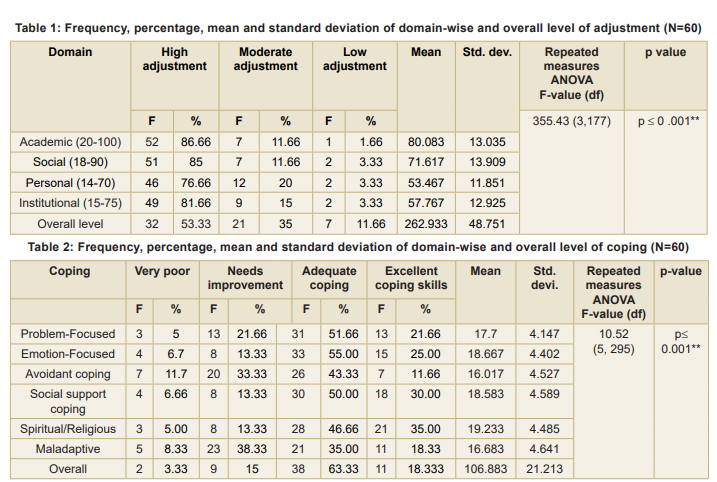
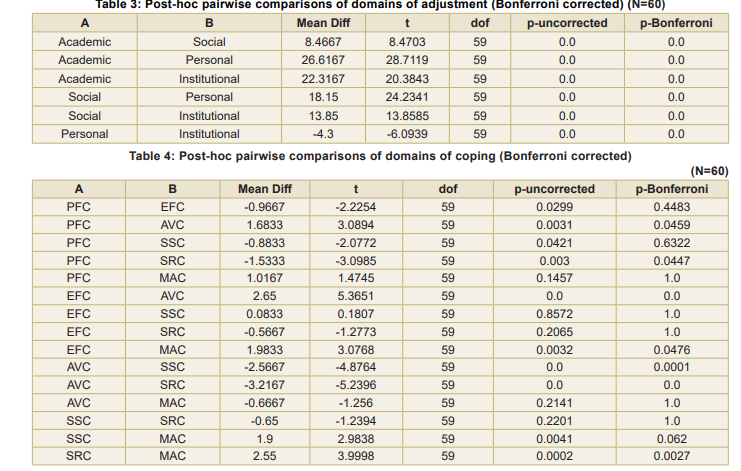
The majority of students reported high adjustment across domains - Academic (86.7%), Social (85%), Personal (76.7%), and Institutional (81.7%). The repeated measures ANOVA revealed significant variability across the domains, F (3,177) = 355.43, p < 0.001. This indicates that adjustment levels differed substantially, with Academic adjustment scoring the highest. Post-hoc tests confirmed significant differences between all domain pairs (all p < .001). Academic adjustment was significantly higher than Social, Personal, and Institutional, while Social was higher than both Personal and Institutional. Personal adjustment was lowest compared to Institutional. This indicates clear differentiation across adjustment domains. This finding aligns with Kaur & Kaur (2023), who reported that first-year nursing students demonstrated better academic and institutional adjustment compared to emotional domains, emphasising that educational structure and routine facilitate external adjustment, but emotional adaptation remains challenging. Similarly, Rani & Thomas (2022) found that academic adjustment is positively influenced by structured learning environments and faculty support, while personal adjustment is hindered by homesickness and self-doubt among new entrants.
Level of Coping
Coping analysis showed that most students had adequate coping (63.3%) with notable reliance on Problem-Focused (51.7% adequate) and EmotionFocused strategies (55% adequate). Spiritual/ Religious coping also emerged as a preferred strategy (46.7% adequate, 35% excellent). The repeated measures ANOVA revealed a statistically significant difference across coping domains, F (5,295) = 10.52, p < 0.001, indicating that coping preferences varied significantly. Pairwise comparisons revealed that Emotion-Focused Coping (EFC) and Spiritual/Religious Coping (SRC) were significantly higher than Avoidance Coping (AVC) and Maladaptive Coping (MAC). Problem-Focused Coping (PFC) was higher than AVC but lower than SRC. These results indicate that students favoured adaptive strategies such as EFC and SRC over avoidant or maladaptive approaches. These findings are consistent with George & Sebastian (2022), who observed that nursing students preferred spiritual and emotionfocused coping, viewing faith and communication as central to managing stress. Likewise, Prakash et al (2021) noted that adaptive coping such as seeking support and positive reframing were more frequent among female nursing students than avoidance mechanisms.
Correlation of adjustmentwith coping of students:
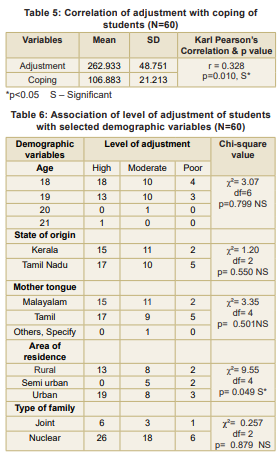
A weak positive correlation was observed between adjustment and coping (r = 0.328, p = 0.010), indicating that higher coping skills were modestly associated with better adjustment among students at 5 percent level of significance. This finding is supported by Mishra & Sahoo (2020), who identified a positive relationship between coping mechanisms and psychological adjustment among undergraduate students, indicating that coping strategies function as mediators in adapting to academic and environmental stress.
Association of the level of adjustment of students with selected demographic variables:
Chi-square analysis revealed that only the area of residence was significantly associated with adjustment (χ² = 9.55, df = 4, p = 0.049), with students’ adjustment varying across rural, semiurban, and urban areas. Other demographic factors, such as age, state of origin, mother tongue, and type of family, did not show significant associations. This observation echoes Kumari & Reddy (2022), who reported that students from rural backgrounds experience greater difficulties in adjusting to hostel life and urban campus environments compared to urban counterparts. Other demographic variables, such as age, family type, and mother tongue showed no significant association, corroborating findings by Das & Paul (2021) that socio-demographic characteristics had minimal influence on adjustment among nursing students.
Association of the level of coping of students with selected demographic variables:
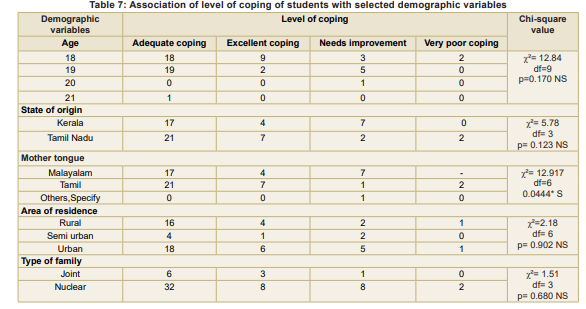
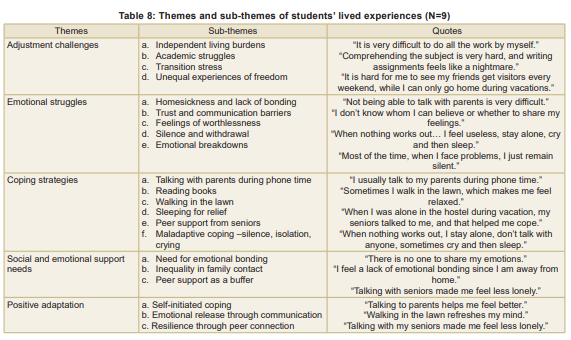
Among the demographic variables analysed, only mother tongue showed a statistically significant association with coping level (χ²=12.92, df=6, p=0.044). This suggests that cultural/linguistic background may influence the way students cope with challenges, possibly through differences in social support structures, values, or coping strategies. Similarly, Joseph & Varghese (2023) found that linguistic and cultural differences influenced the selection of coping strategies among South Indian nursing students, particularly in the preference for family-based and spiritual coping. No significant relationship was found with other variables, aligning with Sujatha & Devi (2022), who reported that coping is more shaped by individual disposition and support networks than demographic characteristics. Frequency, percentage, mean and standard deviation of domain-wise and overall level of adjustment & coping; post-hoc pairwise comparisons of domains of adjustment & coping (Bonferroni corrected); correlation of adjustment with coping of students; association of level of adjustment & coping of students with selected demographic variables; and for qualitative analysis, themes and sub-themes of students’ lived experiences are shown in Tables 1-8.
Qualitative Findings
Thematic analysis of student interviews revealed five overarching themes:
Adjustment challenges (independent living burdens, academic struggles, transition stress, unequal family contact); Emotional struggles (homesickness, lack of bonding, trust issues, silence, feelings of worthlessness, social comparison); Coping strategies (adaptive: talking to parents, reading, walking, sleeping; maladaptive: silence, isolation, crying); Social and emotional support needs (desire for trustworthy relationships, need for bonding, peer support from seniors as a buffer); Positive adaptation (resilience through self-initiated coping and emotional release via communication). The present qualitative findings are supported by Rosa & Mohammed (2022), who also reported that first-year nursing students experienced homesickness, emotional stress, and academic transition difficulties. Students relied on adaptive coping mechanisms such as communication with parents and peer interactions to overcome loneliness and develop resilience.
Integration of Quantitative and Qualitative Findings
Integration of findings revealed convergence between quantitative results and qualitative insights. Although quantitative findings showed high levels of academic and institutional adjustment among the majority of students, qualitative interviews revealed underlying emotional struggles such as homesickness, feelings of loneliness, silence, and emotional withdrawal. These qualitative findings help explain why personal-emotional adjustment scores were comparatively lower than academic and social adjustment. Similarly, while quantitative analysis indicated predominantly adequate coping with greater reliance on emotion-focused and spiritual coping strategies, qualitative data provided deeper insight into how these strategies were practised. Students described coping through talking with parents during phone time, walking, reading, sleeping, and seeking peer support from seniors. At the same time, some students reported maladaptive coping behaviours such as crying, isolation, and remaining silent, which were not fully captured in quantitative scores.
The weak but significant positive correlation between adjustment and coping identified quantitatively was further explained by qualitative findings, which demonstrated that students who actively sought emotional support and used adaptive coping strategies experienced better adjustment. Overall, the qualitative findings expanded and contextualised the quantitative results, providing a comprehensive understanding of first-year nursing students’ adjustment and coping experiences.
Discussion
The findings indicate that structured academic environments support academic and institutional adjustment among 1st year nursing students, while emotional adjustment remains challenging. Adaptive coping strategies, particularly emotional expression and peer support, facilitated better adjustment. These findings are consistent with earlier Indian studies on nursing students’ transition experiences.
Strengths and Limitations
Strengths:Sequential explanatory mixed-method design; Use of validated tools; In-depth qualitative exploration.
Limitations: Single-institution study; Small sample size limiting generalisability.
Implications for Practice & Recommendations
The study highlights the need for comprehensive student support systems within nursing institutions. Counselling services and periodic stress management workshops can address emotional struggles such as homesickness, silence, and feelings of worthlessness. Structured peer mentoring programmes should be introduced to strengthen social support, while parental orientation sessions can help families provide constructive assistance during student transitions. For support to 1st year students, orientation sessions and stress management workshops should be organised to enhance adaptation and resilience. Faculty should be trained to identify students facing adjustment difficulties and provide timely guidance, while maintaining open communication with parents to strengthen emotional support. Regular monitoring of students’ adjustment and coping levels can help implement early interventions and promote overall well-being and academic success. Future research can include larger and more diverse samples across multiple nursing institutions to enhance generalisability. Longitudinal mixedmethod studies are recommended to explore how adjustment and coping evolve throughout nursing education. Intervention-based studies assessing the impact of mentoring, counselling, and wellness programmes on students’ academic and emotional well-being can provide valuable insights for evidence-based educational practices.
Conclusion
First-year nursing students demonstrate satisfactory academic adjustment but significant personal-emotional struggles. Coping strategies were largely adaptive, with family communication and peer support acting as protective factors. Institutions should prioritise structured mentoring, counselling services, and supportive hostel policies to foster holistic adjustment and resilience among first year students.
References
1. Das P, Paul R. Influence of socio-demographic characteristics on adjustment among nursing students. Journal of Nursing Education and Practice 2021; 11(8): 45-52
2. George A, Sebastian M. Coping strategies and perceived stress among nursing students: A descriptive study. Indian Journal of Nursing Studies 2022; 14(2): 67-74
3. Joseph L, & Varghese P. Cultural determinants of coping strategies among South Indian nursing students. Asian Journal of Nursing Research 2023; 8(1): 22-29
4. Kaur P, Kaur R. Adjustment and stress among first-year nursing students in India. Journal of Nursing Science and Education 2023; 13(1): 12-18
5. Kumari SDR, Reddy A. Adjustment problems among rural and urban undergraduate nursing students. Nursing Journal of India 2022; 113(4): 197-203
6. Mishra S, Sahoo M. Relationship between coping and adjustment among college students. International Journal of Indian Psychology 2020; 8(2): 455-62
7. Prakash R, Kiran S, Paul S. Coping mechanisms and stress among female nursing students. International Journal of Nursing Care 2021; 9(2): 40-46
8. Rani A, Thomas J. Academic and emotional adjustment among nursing students: A cross-sectional study. Indian Journal of Mental Health Nursing 2022; 9(2): 89-96
9. Sujatha M, Devi B. Coping styles and their association with demographic variables among nursing students. Journal of Psychiatric Nursing 2022; 11(3): 145-52
10. Rosa EM, Mohammed AF. Lived experiences of first-year nursing students coping with transition challenges in a residential college setting: A qualitative study. Journal of Nursing Education and Practice 2022; 12(6): 45-54
11. Baker RW, Siryk B. Assessing major adjustment problems of first year students in Ethiopia, Wolaita Sodo University. Journal of Counselling Psychology1984; 31(2): 179-89. https://doi.org/10.1037/0022-0167.31.2.179

This work is licensed under a Creative Commons Attribution-NonCommercial-ShareAlike 4.0 International License.