
Cybercrime has emerged as one of the most formidable challenges of the digital era, evolving rapidly with technological advancements and the global expansion of the internet. It encompasses a wide range of illicit activities, including hacking, phishing, identity theft, and data breaches (Payne, 2020). With the growing dependence on technology, particularly among students, the risk of cyber victimisation has intensified. In India, cybercrimes have surged dramatically, with financial frauds and online scams contributing to losses exceeding $20 million in 2024 (Griffith, 2025; Reuters, 2025). Kerala mirrors this alarming trend, with reported cybercrime cases more than tripling between 2017 and 2020, marking a 33 percent rise between 2021 and 2023. Within Ernakulam district alone, incidents have increased by nearly 7.4 times over the past five years, highlighting an urgent need for proactive education and awareness among college students, the most active segment of digital users.
Research from national and international contexts provides valuable insights into cyber awareness. Studies indicate that cybercrime awareness varies by geography, discipline, and socio-demographic factors. In Chhattisgarh, 69 percent of students displayed above average awareness, with urban learners being more informed than their rural counterparts (Sahu & Shukla, 2024). Investigations among higher education students revealed that professional and technical course enrollees tend to possess stronger cyber safety knowledge compared to those in traditional programmes (Kant, 2023; Bala, 2022). Similarly, in Punjab, IT and commerce students had the highest awareness, though understanding of specific threats like identity theft remained limited (Mokha, 2017). Research from Haryana, Gujarat, and other states also highlights that awareness differs by gender, course type, and institutional management (Choudhary, 2020).
International studies corroborate these findings. For instance, research from Saudi Arabia noted that students identified sexual and financial motives as primary drivers of cybercrime and expressed strong interest in preventive education (Alharbi & Tassaddiq, 2021). Studies from Nigeria and other countries reported high general awareness but limited understanding of specific cyber offenses26. These collective observations underscore the multifaceted nature of cyber awareness, shaped by educational exposure, sociocultural factors, and access to digital resources. In this context, the present study among students of different disciplines in selected colleges in Ernakulam district (Kerala) aims to assess and compare the levels of cybercrime awareness among students in different disciplines and provide evidence for designing effective interventions that enhance online safety.
Methodology
The study employed a quantitative research approach using a comparative survey design to assess cybercrime awareness among undergraduate students from selected colleges in Ernakulam district, Kerala. The population included students enrolled in Nursing, Arts and Science, and Engineering colleges. Colleges were selected through convenience sampling, and simple random sampling was employed to select students from different disciplines. Sample size was calculated and a total of 323 participants (Nursing 168, Arts & Science 95, Engineering 60) were included in the study. Limitation of the study was the unequal representation of Arts & Science and Engineering students compared to Nursing students, due to academic schedules and examinations. Additionally, data were collected through physical methods rather than online platforms, which may have limited participation.
Inclusion criteria were students currently pursuing undergraduate courses who were able to read, write, and understand English; students with prior formal training in cybercrime awareness within the past six months were excluded. Data were collected using a structured self-reported questionnaire. Tool 1 was the Socio-demographic proforma, which consisted of 21 items. Tool 2 was Cybercrime awareness questionnaire with 30 items. Scoring of the Tool 2 was categorised as poor (≤10), average (11-15), good (16-20), very good (21-25), and excellent (26-30). The tools were validated by three experts, yielding a content validity index (CVI) of (Tool 2) was 0.8; and reliability was established using the split-half method, with a Karl Pearson correlation coefficient of 0.86.
Administrative permission was obtained from the principals of the colleges, and informed consent was obtained from all participants. A pilot study was conducted among 20 students from each discipline to check the feasibility of the study. Data was mainly collected directly from each participant in the month of May 2025. Time taken was approximately 30 minutes per participant. Completed questionnaires were checked for completeness, coded, and analysed using SPSS software. Descriptive statistics (frequency, percentage, mean, standard deviation) were used to summarise the data. Inferential statistics, ANOVA test was used to compare cybercrime awareness levels across disciplines, and p value < 0.05 was considered statistically significant.
Results
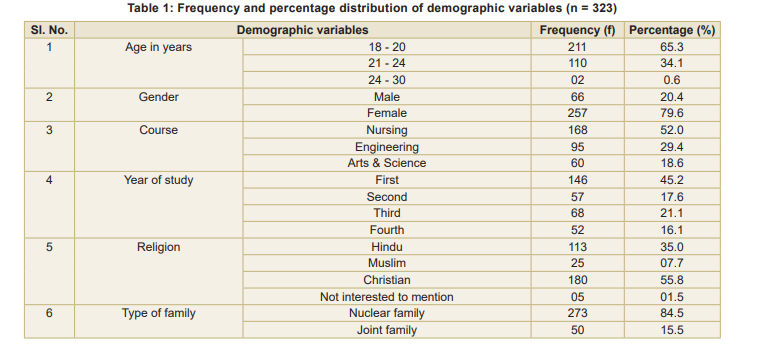
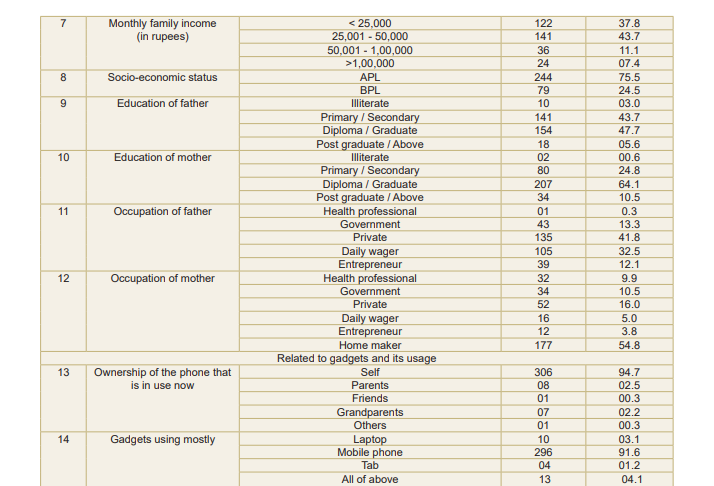
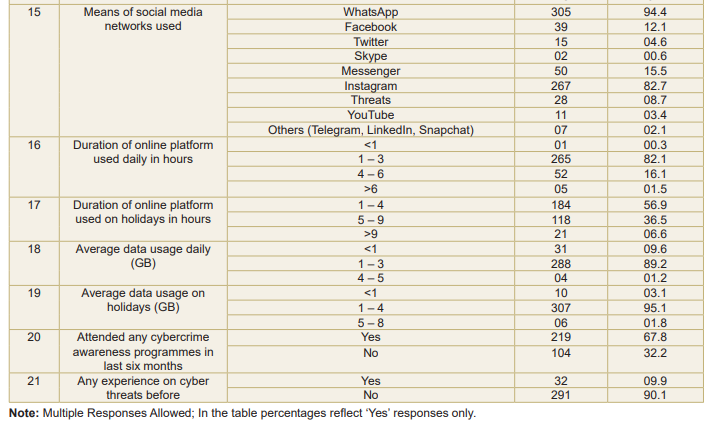
Description of Demographic Variables The demographic parameters of students covered in the study are shown in Table 1.
Assessment of the Level of Cybercrime Awareness among Students Table 2 shows that 22 percent of participants had an excellent level of cybercrime awareness, while only 0.9 percent had a poor level with an overall mean awareness score of 22.9 ± 3.5.
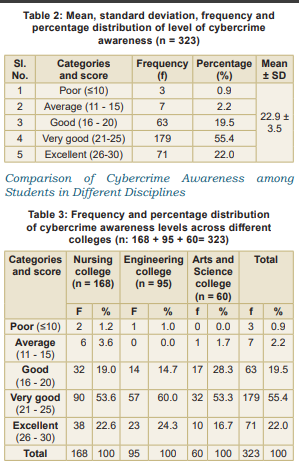
Table 3 shows that a majority of students across Nursing, Engineering, and Arts & Science disciplines demonstrated very good (53-60%) or excellent (16.7-24.3%) cybercrime awareness. These findings indicate a generally high level of cybercrime awareness among students, with slight variations between disciplines.
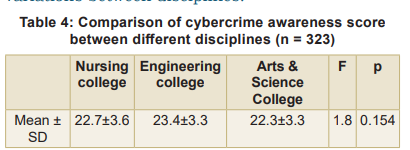
Table 4 indicates no statistically significant difference in cybercrime awareness among disciplines, with comparable mean scores for Nursing (22.7 ± 3.6), Engineering (23.4 ± 3.3), and Arts & Science (22.3 ± 3.3). One-way ANOVA confirmed this finding (F = 1.8, p = 0.154).
Discussion
The present study assessed cybercrime awareness among 323 undergraduate students from Nursing, Engineering, and Arts & Science colleges in Ernakulam district (Kerala) The demographic profile revealed that the majority were aged 18-20 years, predominantly female (79.6%), and mostly from nuclear families (84.5%), with widespread use of mobile phones and online platforms. The findings align with prior research indicating that young adults and urban students are frequent digital users, making them more susceptible to cyber risks (Payne, 2020; The New Indian Express, 2022). Most participants had prior exposure to cybercrime awareness programmes, and the majority reported no personal experience with cyber threats, reflecting a proactive educational environment and the potential influence of digital literacy initiatives (Sahu & Shukla, 2024).
Overall, 55.4 percent of students demonstrated very good knowledge of cybercrime, and 22 percent had excellent awareness, with a mean score of 22.9 ± 3.5. Comparative analysis across disciplines showed no statistically significant difference in cybercrime awareness, suggesting that curriculum differences among Nursing, Engineering, and Arts & Science programmes may not strongly influence awareness in the current context (Mokha, 2017; Rajender, 2017). Urban students and postgraduates showed slightly higher awareness than their rural and undergraduate counterparts, highlighting the role of locality and academic progression in shaping cyber knowledge. These findings are consistent with studies conducted in other Indian states, where professional and urban students displayed better awareness than those from traditional or rural backgrounds (Punjabi, 2024; Meena et al, 2020). Gender differences were minimal, corroborating previous reports that male and female students often exhibit comparable cybercrime knowledge when exposed to similar digital environments (Kant, 2023; Khan, 2019).
Among the demographic variables, only the year of study was significantly associated with cybercrime awareness (p = 0.001), indicating that awareness increases as students advance academically. Firstyear students exhibited lower awareness compared to final-year students, emphasising the need for early inclusion of cyber safety education within college curricula (Himanshukumar, 2024; Khan, 2019). Other variables, including age, gender, socioeconomic status, and parents’ education, were not significantly associated, suggesting that structured educational interventions may be more influential than demographic factors in promoting cyber literacy. The study underscores important implications for nursing practice and education. Community health nurses and educators can play a critical role in raising awareness and training students in secure digital practices, while administrators should implement structured cybercrime programmes. Research should further evaluate tailored interventions to improve cyber awareness across student populations (Himanshukumar & Sharma, 2024; Alharbi & Tassaddiq, 2021).
Conclusion
Future studies should include larger and more diverse samples and compare urban and rural institutions to improve generalisability and understand the influence of technology access. Longitudinal designs are also recommended to assess long-term changes in cybercrime awareness and related behaviours following interventions. The study underscores important nursing implications across practice, education, administration, research, and policy in strengthening cybercrime awareness. Community health nurses play a key role in promoting digital safety by educating patients and healthcare personnel on recognising cyber threats and ensuring secure handling of health information. Integrating cyber security concepts into nursing education can equip students with skills to protect patient data and adopt safe digital practices. Nursing administrators should support structured cyber security programmes and collaborate with IT experts to embed data protection within institutional policies. Further research and supportive policies are essential to evaluate awareness initiatives and promote continuous cyber safety training in nursing and healthcare settings.
The study highlights an overall satisfactory level of cybercrime awareness among college students, with academic progression playing a key role in improving knowledge. The findings emphasise the need for early and structured cyber safety education to strengthen students’ digital security practices.
References
1. Payne BK. Defining Cybercrime. In: The Palgrave Handbook of International Cybercrime and Cyberdeviance. Cham: Palgrave Macmillan; 2020. pp 3-25
2. Charles Griffiths. The latest cyber-crime statistics (Internet). AAG IT (cited 2025, Oct 8). Available from: https://aag-it.com/ the-latest-cyber-crime-statistics
3. Reuters. India says cyber fraud cases jumped over four-fold in FY2024, caused $20 mln losses (Internet). 2025 Mar 11 (cited 2025 Oct 8). Available from: https://www.reuters.com/world/ india/india-says-cyber-fraud-cases-jumped-over-four-foldfy2024-caused-20-mln-losses-2025-03-11/
4. The New Indian Express. Cyber crimes triple in 5 years; 995 cases in 2021 (Internet). 2022 Feb 20 [cited 2025 Oct 8]. Available from: https://www.newindianexpress.com/states/ kerala/2022/Feb/20/cyber-crimes-triple-in-5-years-995-casesin-2021-2421845.html
5. Sahu S, Shukla R. A study on cyber-crime awareness among students in Chhattisgarh. J of Ravishankar Univ (Part-A: Soc Sci) 2024; 30 (1): 54-60
6. Kant R. Cyber-security awareness in India: How much students of higher education are aware. GESJ Educ Sci Psychol 2023; 2(67): 59-72
7. Raj Bala. A study of cybercrime awareness among B.Ed. students. Paripex Indian J Res 2022; 11(4). DOI: 10.36106/ PARIPEX
8. Mokha AK. A study on awareness of cyber crime and security. Res J Humanit Soc Sci 2017 Oct-Dec; 8(4): 459-64
9. Rajender K, Bikram S, Mukesh Y. A study of cyber crime awareness among B.Ed. and M.Ed. students of Sirsa District. J Econ Manag Perspect 2017; 11(3): 74-84
10. Choudhary M. Cybercrime awareness among higher education students from Haryana with respect to various demographical variables. Pal Arch J Archaeol Egypt/Egyptology 2020; 17(7): 14454-61
11. Himanshukumar PD, Sharma AC. A comparative study of cyber-crime awareness in college students of Navsari District. Internat J Multidiscipl Educ Res 2024; 13-11 (2): 84-89
12. Ranjan A, Gorain S, Kishor K, Mirgank DB. Cybercrime awareness among postgraduate students of Rajiv Gandhi University, Arunachal Pradesh. Satraachee 2023; 40(28): 340-47
13. Verma MK, Kushwaha SS. Awareness towards cybercrime among secondary school students: The role of gender and school management. Safer Communities 2021; 20(3): 150-58
14. Verma MK, Kushwaha SS. Awareness towards cybercrime among undergraduate students: The role of gender and college management. Shodh Sanchar Bulletin 2021; 11(41): 116-21
15. Rai K, Kaur B, Sardana S. Awareness of cybercrime against women among students of higher educational institutes in Delhi. In: Performance Management. CRC Press; 2020. pp 163-74
16. Khan A. A study of awareness on cybercrime amongst senior college students of Pune City. Int J Res Anal Rev 2019; 6(1): 167-72
17. Punjabi N. A study on cybercrime awareness among youth in Maharashtra. In: AU Hybrid International Conference 2024 on “Entrepreneurship & Sustainability in the Digital Era” under the theme of “People Centric Knowledge in Intelligence World”. 2024 Sep 25; 4(1): 302-310
18. Meena Y, Sankhla MS, Mohril S, Kumar R. Cybercrime: Youth awareness survey in Delhi NCR, India. Forensic Res Criminol Int J 2020; 8(5): 177-80
19. Maphosa V. An overview of cybersecurity in Zimbabwe’s financial services sector. F1000Research 2024; 12:1251. DOI: 10.12688/f1000research.132823.1
20. Alharbi T, Tassaddiq A. Assessment of cybersecurity awareness among students of Majmaah University. Big Data Cogn Comput 2021; 5(2): 23. DOI: 10.3390/bdcc5020023
21. Yadav D, Singh G, Kartik D, Rai RS. Internet users’ habits and cyber awareness: A cross-sectional study. Pac Bus Rev Int 2019; 11(10): 56-66
22. Kaleeshwari S, Jegadeeshwaran M. Quantitative assessment of the cybersecurity and cybercrime awareness among postgraduate commerce students in the Coimbatore District, India. Asian Journal of Probability & Statistics 2024; 26(9): 185-97 DOI: 10.9734/ajpas/2024/v26i9653

This work is licensed under a Creative Commons Attribution-NonCommercial-ShareAlike 4.0 International License.