
Work plays a central role in adult life, providing financial security and personal fulfilment. However, it is also a significant source of psychological stress. The World Health Organisation defines workplace stress as the harmful physical and emotional responses that occur when job demands exceed an individual’s coping capacity. Globally, depression and anxiety account for approximately 12 billion lost working days annually, emphasising the economic and public health burden of occupational stress.
In India, rapid industrialisation, extended working hours, and performance-driven organisational cultures have intensified workplace stress across professional sectors such as healthcare, information technology, education, and finance. Reports indicate that young and midcareer professionals experience disproportionately high stress levels, increasing vulnerability to burnout, cardiovascular illness, and reduced productivity.
Pune, a major industrial and educational hub in Maharashtra, hosts a diverse professional workforce exposed to demanding work environments. Despite this, regionspecific empirical evidence on workplace stress among professionals remains scarce. Most Indian studies focus on single occupations or metropolitan settings, limiting generalisability. Hence, it was sought to assess the prevalence of workplace stress and its association with selected demographic and occupational variables among professionals in Pune (Maharashtra). There is a lack of region-specific, multiprofessional data examining workplace stress determinants in Pune, underscoring the need for this study to inform localised occupational health interventions.
Statement of the problem: A Questionnaire-Based Cross-Sectional Survey to Assess the Prevalence of Workplace Stress Among the Professionals Working in Various Organizations of Pune, Maharashtra.
Objectives
The study was carried out with following objectives.
1. To assess the prevalence of work-related stress among professionals working in various organisations in Pune (Maharashtra).
2. To find the association between the prevalence of stress and the selected socio-demographic variables.
Review of Literature
Previous studies consistently demonstrate a high burden of workplace stress across diverse professional groups. Kazmi et al (2024) reported that 80 percent of marketing professionals experienced high occupational stress among middle-aged workers in Karnataka. Among healthcare professionals, Abraham et al (2023) found that half of the doctors surveyed had severe stress, with stress levels significantly associated with age, education, and work experience. Similarly, Darshan et al (2013) observed that 51.2 percent of Indian IT professionals experienced occupational stress, with a substantial proportion also at risk for depression.
Evidence further indicates important health and productivity consequences of workplace stress. Jagtap et al (2022) reported that 54 percent of university employees in Maharashtra experienced moderate to high stress, and those individuals were 2.5 times more likely to have hypertension. Roy (2022) found significant positive correlations between workplace stress and occupational exhaustion and depersonalisation among mental health professionals. At an international level, Bui et al (2021) demonstrated a significant inverse relationship between stress and productivity, while Sime et al (2022) identified poor working conditions, limited organisational support, and substance use as significant predictors of work-related stress. Collectively, these findings highlight the widespread prevalence and adverse consequences of workplace stress, underscoring the need for region-specific research among diverse professional populations.
Methodology
A descriptive cross-sectional design was used to assess the prevalence of workplace stress among Professionals working in various organisations of Pune (Maharashtra). The inclusion criteria for the study were: professionals currently employed in various organisations of Pune, both male and female; age 21 years or higher; willingness to participate in the study and provide informed consent. Participants suffering from any preexisting mental illness were excluded.
A sample size of 430 participants was taken by using a non-probability convenience sampling technique. The sample size was determined using statistical methods. Based on a study conducted by Darshan et al (2013), the prevalence of professional stress among Indian IT professionals was reported as 51.2 percent.
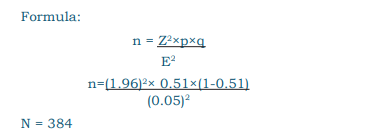
Where, n = required sample size, Z = standard normal variate corresponding to 95% confidence level (1.96), p = expected prevalence or proportion from previous study, q = (1 - p), E = allowable error (precision).
Calculated sample size was 384; however, 430 participants were included in the study. Data were gathered using the standardised Workplace Stress Scale, which was administered through a Google Form and distributed to eligible participants during September to October 2024. The research variable was prevalence of workplace stress among professionals in various organisations. The Standardised Questionnaire Workplace Stress Scale (WSS) was developed by the American Institute of Stress (AIS) and Merlin company in 1978 and modified in 2001 (Workplace Stress ScaleTM, 1978). The items assessed various aspects of workplace stress, such as job pressure, workload, support from supervisors, control over work, and job satisfaction. The final scoring and interpretation are based on the following aspects:
Ethical Consideration
Ethical approval was obtained from Institutional ethical committee. Informed consent was obtained through a mandatory consent question in Google Forms. Confidentiality and anonymity of participants were maintained throughout the study and they were given right to withdraw from the study at any stage without penalty.
Results
The data obtained from the study subjects were analysed and interpreted in terms of the objectives of the study. Descriptive and inferential statistics was done, and SPSS ver18 IBM was used for the same.
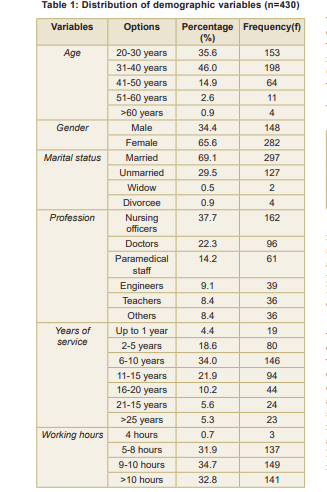
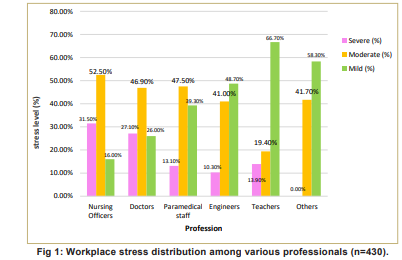
Table 1 shows that majority of samples (46%) were in the age group of 31-40 years, 65.6 percent of samples were females, 69.1 percent of samples were unmarried, 37.3 percent of samples were nursing Officers, 34.0 percent of samples had 6-10 years of service, 34.7 percent of samples were working daily for 9-10 hours.
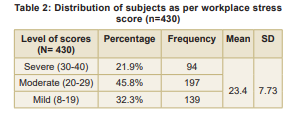
Table 2 represents that out of 430 participants, majority of samples i.e. 197 (45.8%) had moderate stress, 139 (32.3%) of samples had mild stress and 94 (21.9%) of samples had severe stress. The primary reasons for stress might be long working hours, workload pressure, and lack of adequate coping resources.
Distribution of workplace stress among various professionals is shown in Fig 1. Analysis of the severity of workplace stress levels among various professionals indicates that majority of nursing officers (52.5%) and doctors (47.9%) experienced moderate stress. Teachers (66.7%) and others (58.3%) predominantly reported mild stress, suggesting lower levels of stress intensity in these groups. Paramedical staff demonstrated a relatively balanced distribution across all stress levels, whereas engineers primarily experienced mild stress (48.7%).
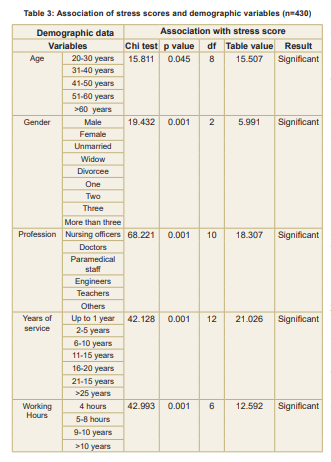
Table 3 shows association of demographic variable with workplace stress score. Results showed that there is strong association between stress score and various demographic variable like age, profession, gender, years of service and working hours. However, there was no association between stress score and marital status.
Discussion
The current study’s findings aimed to assess the prevalence and extent of work-related stress among professionals. The results revealed a mean stress score of 23.4 (SD = 7.73), with a median of 24, which corresponds to a moderate level of stress as per
the interpretation criteria of the Workplace Stress Scale. Notably, 45.8 percent of participants reported experiencing moderate stress, 32.3 percent had mild stress, and 21.9 percent had severe stress, suggesting that nearly two-thirds of the study population were facing moderate to high levels of occupational stress. This level of stress prevalence is consistent with findings from both national and international studies. The results are consistent with a study conducted by Vellaidurai et al (2024) in Tamil Nadu, India, who concluded that among the 200 participants the mean PSS score was 23.21±7.74. Among the study participants 116 (58%) had moderate stress, 67 (33.50%) participants had high stress and 17 (8.50%) had low stress. For instance, the LinkedIn Workforce Confidence Index Survey (2021) found that 55 percent of Indian professionals reported being stressed at work, with contributing factors including poor work-life balance, insufficient income, and limited career growth opportunities. Similarly, a cross-sectional study conducted in Chennai, Tamil Nadu (2021) indicated that 20.3 percent reported high stress levels and about 70.02 percent reported moderate stress levels (Nithya et al, 2022). Nurses are the most affected group. The findings indicate a moderate level of workplace stress among professionals, with healthcare workers, particularly nursing officers, being disproportionately affected.
The high prevalence of stress among individuals aged 31-40 years, females, and those with longer working hours highlight the vulnerability of mid-career professionals juggling multiple responsibilities. Significant associations between stress and work-related factors such as profession, years of service, and extended hours reinforce global evidence that poor work design and staffing shortages contribute to psychological strain. These results underscore the urgent need for targetted interventions, such as staffing support, shift restructuring, and mental health resources, especially in healthcare settings, to mitigate the growing burden of occupational stress in India.
Implication of the Study For nursing practice: The study emphasises the importance of integrating regular mental health assessments into routine practice.
For nursing research: Future research should focus on intervention studies to evaluate the effectiveness of specific stress-reduction strategies.
For nursing administration: Administrators play a critical role in promoting a healthy work environment through optimal workload distribution, positive organisational culture, and access to counselling and psychological support services.
Study Limitations
Although the study provides valuable insights, the findings should be interpreted considering that the Workplace Stress Scale, while standardised, was adapted for online administration in this setting. Reliability was supported by prior validation studies; however, further psychometric evaluation in diverse Indian occupational groups is recommended.
Recommendations
1. Establish open communication channels between staff and management.
2. Implement employee wellness programmes and relaxation activities.
3. Conduct regular training on stress management.
4. Future research should include larger samples and mixed methods for in-depth understanding.
Conclusion
This study highlights that workplace stress is prevalent among various professionals including healthcare workers, especially nursing officers, facing the highest burden. Key factors are long working hours, years of service, and professional role significantly influence stress levels. Addressing these stressors is essential to improve employee well-being, job satisfaction, and overall workplace efficiency.
The study emphasises the need for effective workplace interventions and stress management programmes tailored to organisational and professional demands. Future research with larger, diverse sample and longitudinal design is recommended to deepen the understanding and develop comprehensive, evidence-based strategies for workplace stress.
Acknowledgement
We thank all study participants for their honest participation. We are also thankful to our institution who provided us support and encouragement to conduct this study.
1. Abraham PA, Thomas SC Nair AR, Kuriakose A, Gopinath GG. Workplace stress among doctors of a medical college in sourth India. Inter Medicine 2023;1-5
2. Roy A. Workplace stress as a predictor for burnout in mental health professionals: A Covid-19 Study. Intern J Indian Psychol 2022; 10 (4): 843-49. doi: 10,25215/1004, 081
3. Sime Y, Hailes 1H, Alenko A. Work-related stress and associated factors among employees of Hawassa industrial park, Southern Ethiopia: An institutional-based cross-sectional study.BMC Psychiatry 2022, Dec; 22(1) 387
4. World Health Organization. Occupational Health. Stress at the workplace. 2020. Available from: https://who-dev5.prgsdev.com/m/news-room/questions-and-answers/item/ccupational-health-stressat-the-workplace. http://www.who.int/occupational_health/topics/stressatwp/en
5. Business Standard. Workplace stress on the rise: 64% of young professionals feeling the heat. 2024, Oct 1 [cited 2025 Jun 6]. Available from: https:// www.business-standard.com/india-news/workplacestress-on-the-rise-64-of-young-professionals-feeling-the-heat-124100100437_1.html
6. Jagtap A, Mahajan U, Kudale A. Prevalence of hypertension and perceived stress among university employees in Solapur, India, 2022). J Occup Health Epidemiol 2024 Sep 1; 13(3): 166-73
7. Kazmi SSH, Shukla J, Tripathi RK, Zaidi SZH. Occupational stress among middle-aged professionals in India. [Internet] 2024 Apr; 31(2): 95-104
8. Bui T, Zackula R, Dugan K, Ablah E. Workplace stress and productivity: A cross-sectional study. Kans J Med 2021 Feb 12 [cited 2025 May 21]; 14: 40-44
9. Darshan MS, Raman R, Sathyanarayana Rao TS, Ram D, Annigeri B. A study on professional stress, depression and alcohol use among Indian IT professionals. Indian J Psychiatry 2013; 55: 63-69
10. The Workplace Stress ScaleTM. The Marlin Company, American Institute of Stress. 1978. Available from - https://www.stress.org
11. Vellaidurai S, Krishnan RA, Udayakumar AJ, Siva D. A cross-sectional study on stress and its determinants among doctors in Tirunelveli district, Tamil Nadu. Int J Community Med Public Health 2024; 11: 1212-16
12. India Today Web Desk. World Mental Health Day: 55% of Indian employees feel stressed, says LinkedIn report [Internet]. India Today 2021 Oct 10 [cited 2025 Jun 7]
13. Nithya V, Patel RG, Swetha NB. Prevalence of psychological problems among healthcare workers in a tertiary care hospital, Chennai, Tamil Nadu. Natl J Community Med 2022; 13(1): 13-17. DOI: 10.5455/ njcm.20210819045752

This work is licensed under a Creative Commons Attribution-NonCommercial-ShareAlike 4.0 International License.