
All health care institutions require leaders who can successfully overcome challenges, make decisions and meet the organisation’s goals. Irrespective of their position or experience, every nurse is expected to play a leadership role (Jiang, 2023; Ramseur et al, 2018). Developing leadership skills among the budding nurses is one of the important goals of nursing education. It is evident in the World Health Organisation’s State of the World’s Nursing Report 2020, which emphasises the need for investing in education to enable nurses to become current and future leaders in healthcare (WHO, 2020).
Evidences suggest that nursing educational institutions can equip future nurses with leadership concepts and skills to lead within their clinical practice effectively, contribute to team dynamics, and advance the profession (Curtis et al, 2011; Careau et al, 2014). A well-designed nursing curriculum is important for achieving this goal (Alilyyani et al, 2024). Studies show that many nursing curricula lack sufficient leadership training, leaving graduates feeling unprepared for leadership roles (Curtis et al, 2011).
However, limited studies have explored the effect of the current undergraduate curriculum in developing leadership abilities and teamwork attitudes among nursing students in India.
Research in this area can bridge this gap, providing valuable insights for future studies and improving the preparation of nursing students for effective teamwork and better healthcare outcomes.
This study sought to assess the effect of the current nursing curriculum on developing leadership skills and teamwork attitude of nursing students.
Objectives
This study was conducted:
- to determine the effect of the current undergraduate nursing curriculum in developing (a) leadership skills, and (b) teamwork attitude among BSc Nursing students; and - to compare the opinion of the 2nd semester and 7th semester BSc Nursing students about the effect of the current undergraduate nursing curriculum on developing leadership skills.
Operational definitions
In this study:
‘Effect of current undergraduate nursing curriculum’ refers to the ability of the current undergraduate nursing curriculum based on the INC syllabus in developing leadership skills and teamwork attitude of nursing students, which is assessed by comparing 2nd and 7th semester BSc nursing students;
‘Leadership skills of nursing students’ refers to the abilities and competencies used by nursing students to guide, motivate, and inspire a team or group towards a shared goal as measured by the Leadership Skill Questionnaire;
‘Teamwork attitude of nursing students’ refers to the BSc Nursing students’ mindset and behaviour in collaborating effectively as a team towards a common goal, which is measured by the Team STEPPS Teamwork Attitudes Questionnaire (T-TAQ).
Hypotheses
H1: There is a significant difference between the 2nd Semester and the 7th Semester BSc Nursing students in their leadership skills score.
H2: There is a significant difference between the 2nd Semester and the 7th Semester B.Sc. Nursing students in their teamwork attitude score.
H3: There is a significant difference between the 2nd Semester and the 7th Semester BSc Nursing students in their opinion about the effect of the undergraduate nursing curriculum on developing leadership.
H4: There is a significant correlation between leadership skills, teamwork attitude and the opinion about the effect of the curriculum in developing leadership skills of BSc Nursing students.
Review of Literature
Literature review shows that strong nursing leadership is essential for improving quality in patient care, patient outcomes, staff morale, supportive work environment and staff retention (Jiang, 2023; Sohmen, 2013). It is important to equip nurses with leadership skills, especially during nursing training (Alilyyani et al, 2024; WHO 2020). Integration of leadership training into nursing curriculum has a positive impact on nurses' leadership skills and practice (Curtis et al, 2011; Hashish et al, 2022; Gozde & Abaan, 2011).
A study in Saudi Arabia among nurses and interns found that leadership training enhances the overall self-efficacy, leadership and managerial skills (Alilyyani et al, 2024).
Another study reported that nursing leadership skills and teamwork abilities are developed in a safe, authentic clinical environment if students are given opportunities.
Leadership training helped students to expand their understanding of what is required when they graduate as nurses and contribute to the emergence of nursing identity (Cummings et al, 2008; Reime et al, 2022).
Strategies like simulations, flipped classroom, self-instructional module, partnership between educational institution and hospital and practice sessions are effective in improving leadership abilities of nursing students (Ramseur et al, 2018; Curtis et al, 2011; Martins et al, 2019).
Methodology
The study employed a descriptive comparative design. It was conducted in four selected nursing colleges in North Kerala. The sample size, calculated based on previous study findings, was 158.89 participants per group. The study included BSc Nursing students in their 2nd and 7th semesters from the selected colleges. A total of 305 students in the 2nd semester and 259 students in the 7th semester were approached, out of which 268 and 233 students responded, respectively. Cluster sampling was used for sample selection, involving the following steps: first, four districts were selected by lottery method from North Kerala; then, one college was chosen by lottery method from each district.
The study utilised the following tools:
1. Personal Data Sheet: A self-reporting format to collect demographic information,
2. Team STEPPS Teamwork Attitude Questionnaire: A standardised tool to assess teamwork attitudes, with an internal consistency Cronbach's alpha of 0.883,
3. Leadership Skills Questionnaire: A standardised tool to evaluate leadership skills, with an internal consistency Cronbach's alpha of 0.943,
4. Researcher-Prepared Opinionnaire: To assess students' opinions on the effect of the BSc Nursing curriculum on developing leadership skills, with a test-retest reliability Karl Pearson correlation coefficient of 0.85. The tools were validated by seven nursing experts, yielding a Content Validity Index of one (CVI= 1). A pilot study conducted on 20 May 2025, demonstrated the feasibility of the tools and study design.
Before data collection, permissions were obtained from the institutional ethics committee and the authorities of the concerned colleges. Researchers visited the colleges on fixed dates, met the students in their classrooms, explained the study and ensured the confidentiality of the data. Informed consent and data were collected through Google Forms.
Results
Analysis was done with SPSS. Hypotheses were tested at the 0.05 level of significance.
Subject characteristics: The mean age of the students was 20.37 years, and 81.24 percent were female and 18.76 percent were male. 2nd semester students were 53.49 percent and 46.51 percent were from the 7th semester.
Effect of the current undergraduate nursing curriculum on developing leadership skills and teamwork attitude among nursing students
The effect of the current undergraduate nursing curriculum in developing leadership skills and teamwork attitude was checked by comparing the leadership skills, teamwork attitude and opinion about the effect of the curriculum of 2nd semester and 7th semester BSc Nursing students.
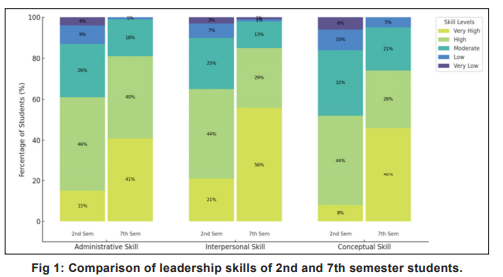
Comparison of leadership skills of 2nd and 7th semester students showed a marked improvement in administrative skills, interpersonal skills and conceptual skills (Fig 1). When comparing administrative skill, only 15 percent of 2nd semester students had very high scores, whereas 41 percent of 7th semester students had very high administrative skill. Similarly, 21 percent of 2nd semester students had very high scores of interpersonal skills, whereas 56 percent of 7th semester students had very high scores. Also, 8 percent of 2nd semester students had very high scores of conceptual skills, whereas 46 percent of 7th semester students had high to very high scores of conceptual skills.
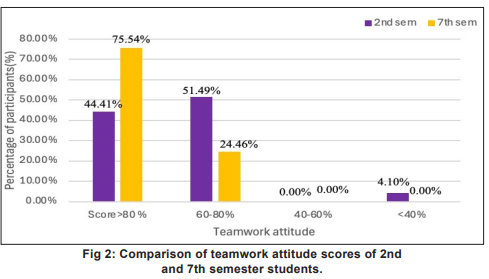
While comparing teamwork attitude, it was revealed that only 44.41 percent of 2nd semester students had excellent scores (>80%), whereas 75.54 percent of 7th semester students had excellent scores (Fig 2). This shows a marked improvement.
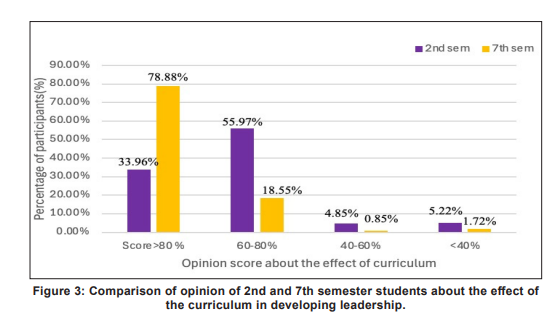
As for the opinion of students about the effect of the curriculum in developing leadership skills, a great majority (78.55%) of 7th semester students reported that it is highly effective (> 80% score) in developing leadership skills, whereas only 48 percent of 2nd semester students reported that it is highly effective (Fig 3).
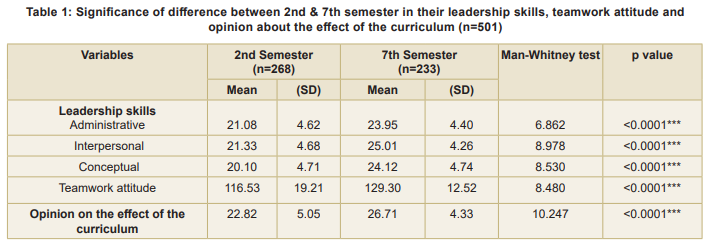
The 7th semester students showed a highly significant (p<0.0001) improvement in leadership skills (Administrative, Interpersonal & conceptual), teamwork attitude and opinion about the effect of curriculum in developing leadership than 2nd semester students (Table 1). It shows that the current undergraduate nursing curriculum is effective in developing leadership skills and teamwork attitude among nursing students.
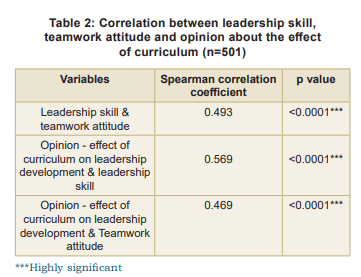
Table 2 illustrates that there was a significant positive correlation between (a) leadership skill and teamwork attitude, (b) opinion on effect of curriculum on leadership development, and leadership skill, (c) opinion on effect of curriculum on leadership development & teamwork attitude with p value <0.0001.
Discussion
The current undergraduate nursing curriculum significantly improves leadership skills and teamwork attitude in nursing students, with a p value of 0.000. Among the 2nd semester students, 15 percent had very high administrative skills, 21 percent had very high interpersonal skills, and 8 percent had very high communication skills, which increased to 41 percent, 56 percent, and 46 percent, respectively, in 7th semester students. Only 44.41 percent of 2nd semester students had an excellent teamwork attitude, which was increased to 75.54 percent in the 7th semester.
No similar studies were identified in the literature. Present findings are in line with those of four studies that checked the effect of various training programmes on leadership skills. A quasi-experimental study to compare the effect of a course of "Leadership in Nursing” delivered in a flipped classroom format showed improvement in the leadership skills of students (Gozde & Abaan, 2021). Another study done in Saudi Arabia, the participants reported that developing curriculum, training, workshops, reviewing the research regarding leadership, and applying the various styles of leadership, helps in developing different leadership styles. A third study in Riyadh revealed significant effects of the leadership development programme on the perceptions of nurses on their essential leadership knowledge and the ability to implement competencies like technical, human, conceptual, leadership skills, and financial management. The fourth study found that partnering of training institutions and hospitals, and experienced leaders as facilitators, helps in developing leadership (Martins et al, 2019). Our study showed a significant correlation between leadership skills and teamwork attitude. Similar findings were observed in previous studies also (Sohmen Victor, 2013; Panicker & Lee, 2020).
Implications
The findings confirm that the undergraduate nursing curriculum plays a vital role in developing leadership skills and teamwork attitude. However, as not all 7th semester students demonstrated excellent leadership abilities, incorporating interactive methods like simulations, workshops, and mentorship can further enhance their leadership proficiency.
Limitations
Generalisability might have been affected due to variations in implementing the curriculum in different institutions; further, only the reported leadership skills and teamwork attitudes were assessed and the leadership skills in a real clinical setting could not be assessed.
Recommendations
-The scope of the study can be enlarged by including diverse institutions across the country.
- Studies may be designed to evaluate the impact of targetted learning interventions such as SBL and scenario-based training on improving leadership skills and teamwork attitudes.
- Studies may be conducted to assess the practical application of leadership skills in real-time clinical settings.
Conclusion
The current undergraduate nursing curriculum is effective in developing leadership skills and a teamwork attitude in nursing students. It significantly improves administrative, interpersonal, and conceptual skills. There is a positive correlation between leadership skills and teamwork attitude. There is scope for special leadership training programmes for developing nurses with very high leadership skills.
1. Jiang X. Nursing leadership: Key element of professional development. Int J Nurs Sci 2024 Jan 5;11(1): 1-2. doi: 10.1016/j.ijnss.2023.12.015. PMID: 38352289; PMCID: PMC10859573
2. Alilyyani B, Althobaiti E, Al-Talhi M, Almalki T, Alharthy T, Alnefaie M, et al, Nursing experience and leadership skills among staff nurses and intern nursing students in Saudi Arabia: A mixed-method study. BMC Nursing 2024; 23(1): 87
3. Ramseur P, Fuchs MA, Edwards P, Humphreys J. The implementation of a structured nursing leadership development programme for succession planning in a health system. Journal of Nursing Administration 2018; 48(1): 25-30
4. World Health Organisation. State of the World's Nursing 2020: Investing in Education, Jobs and Leadership. Geneva: World Health Organisation, 2020
5. Curtis EA, Sheerin FK, Vries JD. Developing leadership in nursing: the impact of education and training. Br J Nurs 2011; 14; 20(6): 344-48 Passim. doi: 10.12968/ bjon.2011.20.6.344. PMID: 21471889
6. Careau B, Biba G, Brander R, Van Dijk JP, Verma S, Verma S, et al. Health leadership education programs, best practices, and impact on learners; knowledge, skills, attitudes, and behaviors and system change: A literature review. Journal of Healthcare Leadership 2014; (6): 39-50
7. Alilyyani B, Althobaiti E, Al-Talhi M, Almalki T, Alharthy T, Alnefaie M, et al, Nursing experience and leadership skills among staff nurses and intern nursing students in Saudi Arabia: A mixed-method study. BMC Nursing 2024; 23(1): 87
8. Sohmen Victor S. Leadership and teamwork: Two sides of the same coin. Journal of IT and Economic Development 2013; 4 (2): 1-18
9. Panicker R, Lee MCC. Transformational Leadership and Teamwork Attitude: Trust and Collective Efficacy as Mediators. European Proceedings of Social and Behavioural Sciences EpSBS The 13th Asian Academy of Management International Conference 2019. EPSBS 2020; 2357-30. DOI: 10.15405/epsbs.2020.10.68
10. Hashish EAA, Bajbeir EF. The effect of managerial and leadership training and simulation on senior nursing students’ career planning and self-efficacy. SAGE Open Nursing 2022; 8 doi:10.1177/23779608221127952
11. Gozde Ozaras Oz, Suheyla Abaan. Use of a flipped classroom “Leadership in Nursing” course on nursing students' achievement and experiences: A quasi-experimental study. Journal of Professional Nursing 2021; 37(3): 562-71. ISSN 8755-7223. https://doi. org/10.1016/j.profnurs.2021.02.001
12. Cummings G, Lee H, Macgregor T, Davey M, Wong C, Paul L, et al. Factors contributing to nursing leadership: A systematic review. Journal of Health Services Research & Policy 2008; 13(4): 240-48. doi:10.1258/ jhsrp.2008.007154
13. Reime MH, Bell K, Albrigtsen B, Beisland EG. Baccalaureate nursing sudents’ reflections on professional development within the nursing leadership role when participating in student-run teams: A qualitative content analysis of students’ reflection notes. SAGE Open Nursing 2022; 8. doi:10.1177/23779608221130604
14. Martins BG, Silva LMC, Capaccioli BRBS, Neves VR, Balsanelli AP. Development and validation of a leadership training program for nurses. Texto Contexto Enferm 2019; 28(3): e20180048. Available from: http://dx.doi. org/10.1590/1980-265X-TCE-2018-0048

This work is licensed under a Creative Commons Attribution-NonCommercial-ShareAlike 4.0 International License.