
The incidence of dementia is estimated to rise from about 57.4 million people in 2019 to about 152.8 million by 2050 globally (Nichols et al, 2022); of these, 60 percent live in low and middle-income countries. About 71 percent new cases of dementia are expected to come from these countries (World Health Organisation, 2017-25).In 2020, India had about 7.4 percent (8.8 million) of older adults with dementia (Lee et al, 2023). As the ageing population increases, and as older people above 60 years are most likely to be hospitalised (Key Indicators of Social Consumption in India, 2019), it is quite likely that nurses would have encountered people living with dementia in the hospital or in the community, and nurses need to provide person-centred dementia care for them. So, nurses need adequate knowledge and positive attitudes towards dementia care (Evripidou et al, 2019)
Need of the study:
Many studies across the world have reported on nurses’ knowledge and attitudes about dementia care, yet such studies in India are few in number, and none of them are from North East India. Also, these studies are mostly confined to one health care facility or to a smaller number of nurses. So, it is important to address the gap in the literature on the knowledge and attitudes of nurses about dementia care in North East India.
Objectives
The primary objectives of this study were to estimate the level of knowledge of nurses regarding dementia and to describe the attitude of nurses regarding dementia. Secondary objectives were to examine the association between knowledge of nurses regarding dementia and socio-demographic variables, and to examine the association between attitudes of nurses regarding dementia and sociodemographic variables
Review of Literature
The review of literature was carried out in Google Scholar, Remote Xs platform and PubMed using the key terms ‘Dementia knowledge’, ‘Dementia attitudes’, ‘nurses’ and ‘person-centred care’.
In a systematic review of 19 studies involving 4274 nurses from Europe, the United States, Australia, Korea and Israel, it was found that nurses have limited knowledge on the epidemiology, diagnosis and specific aspects of dementia care such as communication strategies, non-pharmacological management of behavioural problems, management of co-existing mental health problems, promoting patient safety and engaging people with dementia in appropriate activities. Nurses were also found to have negative attitudes towards dementia associated with the progression of the disease and their inability to handle memory and behavioural problems of people with dementia. However, nurses younger than 40 years of age, and those with more than 10 years of experience, those who work in mental health or who had specialised training on dementia had more hopeful attitudes (Evripidou et al, 2019).
Studies from Asia also showed that nurses have inadequate knowledge and poor attitudes towards dementia. In Hanoi, Vietnam, the knowledge and attitudes of dementia among 269 geriatric nurses from six hospitals assessed using the Dementia Knowledge Assessment Scale (DKAS) and the Dementia Attitudes Scale (DAS) showed that the mean DKAS score was 28.1 (±8.0)/50 and the mean DAS score was 102.1 (±13.4)/140. Nurses in this study had good knowledge of dementia care but poor knowledge about dementia characteristics and communication with people with Dementia (Nguyen al, 2024). The attitudes of nurses in this study showed that they lack social comfort to provide care for people with dementia. Similarly, in China, a study among 431 nurses showed that their knowledge score of dementia using the Alzheimer’s disease knowledge scale (ADKS) was 20.9 (±2.3)/ 30 and their attitudes score using the DAS was 90 (±15.7)/140 (Zhao et al, 2022). As for India, in one study involving 61 nurses from a tertiary healthcare facility in Uttar Pradesh, the knowledge scores of nurses on dementia using the ADKS were found to be 19.1 (±1.9)/ 30 (Singh et al, 2022). Another study from a medical college in West Bengal among 27 nurses, which assessed their knowledge of dementia using a case vignette, reported that nurses had moderate to inadequate knowledge of dementia (Strøm et al, 2019). A pilot study involving 15 nurses from three nursing homes in India showed similar results on the knowledge of nurses towards dementia (Ellajosyula et al, 2022). A qualitative study from India among 15 nurses on the knowledge and attitudes of nurses towards people with dementia projected that people with dementia is a mystery and caring for them is very challenging; however, dementia education can help nurses provide better care (Dookhy & Daly, 2021).
Materials and Methods
This cross-sectional study was conducted across 10 secondary and tertiary hospitals of Shillong, Meghalaya, North East India, between June and October 2023. These 10 hospitals, four government and six private hospitals, gave permission to conduct the study among their nurses and provided the contact numbers of their nurses as well. The total number of nurses working in all 10 hospitals was about 2000, which was taken as the sampling frame.
The inclusion criteria for this study were registered nurses who worked in secondary and tertiary health care institutions in Shillong (Meghalaya), and who were involved in direct patient care. The nurses working in paediatric hospitals, nursing faculty, nursing administrators and nurses from hospitals that refused permission to conduct the study were excluded.
The sample size was calculated using the ‘OpenEpi sample size calculator’ for crosssectional studies. The prevalence of knowledge of nurses on dementia from previous studies (Nguyen et al, 2024; Ellajosyula et al, 2022) was 50 percent and with an absolute precision of 5 percent, the sample size calculated was 323. Taking a non-response rate of 20 percent, the sample size required for this study is 389. Simple random sampling was used in the study. A list of all the nurses with identifying numbers from the 10 hospitals was listed in MS Excel, and using random number generation, the required sample of 389 was drawn.
Online mode of data collection was chosen because of the dispersion of participants across the city and the inability to meet every participant individually due to their schedules, as conveyed by the authorities. The consent form and questionnaire were sent as Google Forms over the social media platform, WhatsApp and Text messages. Only those who gave consent to participate were provided the questionnaire. Despite contacting all 389 nurses, only 114 responded.
Data Collection Instruments
Socio-demographic variables: These included age, gender, qualification, any additional training on dementia, years of experience in nursing practice and history of care of people living with dementia in hospital or at home.
Dementia Knowledge Assessment Survey version 2 (DKAS version 2): It was developed by the Wicking Dementia Research and Education Centre,
University of Tasmania. It has 25 items with scores ranging from 0 to 50. This scale has four subscales, namely Causes and Characteristics, Communication and Behaviour, Care considerations and Risks and Health promotion. The maximum score for the subscale Causes and Characteristics is 14, while for the other three sub-scales, the maximum score is 12. The scale was obtained on request from the developers.
Dementia Attitudes Scale (DAS): The DAS was developed by Melissa L. O'Connor, School of Ageing Studies, University of South Florida and Susan H McFadden, Department of Psychology, University of Wisconsin, USA. It has two components, Dementia Knowledge and Social Comfort. It is a 7-point Likert Scale containing 20 statements, 14 positive and 6 negative. Each statement has a maximum score of 7 and a minimum of 1. Negative statements are given reversed scoring. The total score is 140, and the lowest possible score is 20. The scale was obtained on request from the developers.
Ethical consideration:
This study was approved by the Institutional Ethics Committee. Permission to conduct the study and to obtain contact numbers of the participants was obtained from the competent authorities of the hospitals. Electronic consent was obtained from the participants. Confidentiality of the contact details and the responses of the participants was maintained throughout the study.
Results
The data was analysed using SPSS version 25. Quantitative analysis using mean with standard deviation and percentages was used to analyse numerical data. Chi-square test was used to find the association between the socio-demographic variables and DKAS version 2 or DAS.
Socio-demographic variables:
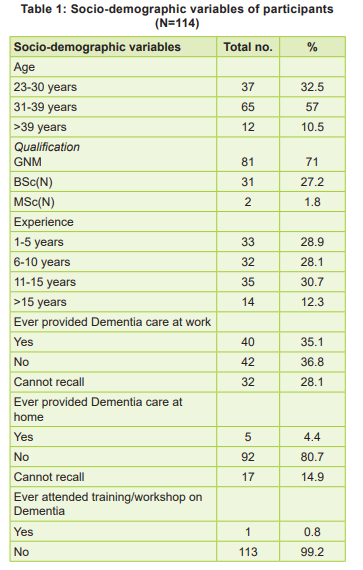
Among the 114 participants in this study, 109 (95.6%) were female. All the participants were Registered Nurses, aged between 23 to 48 years, with a mean age of 33. The mean years of experience of the participants were 8.5 years. The numerical data was normally distributed (Table 1).
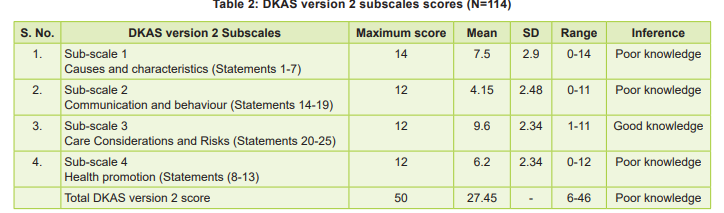
Dementia Knowledge Assessment Scale (DKAS) version 2: The mean DKAS version 2 score was 27.45 (±6.7)/ 50 (range: 6-46). Table 2 shows the mean scores of the four domains. The domain with the lowest mean score (4.15/12) is Communication and behaviour. Chi-square test showed no significant association between knowledge and socio-demographic variables.

Dementia Attitudes Scale (DAS):
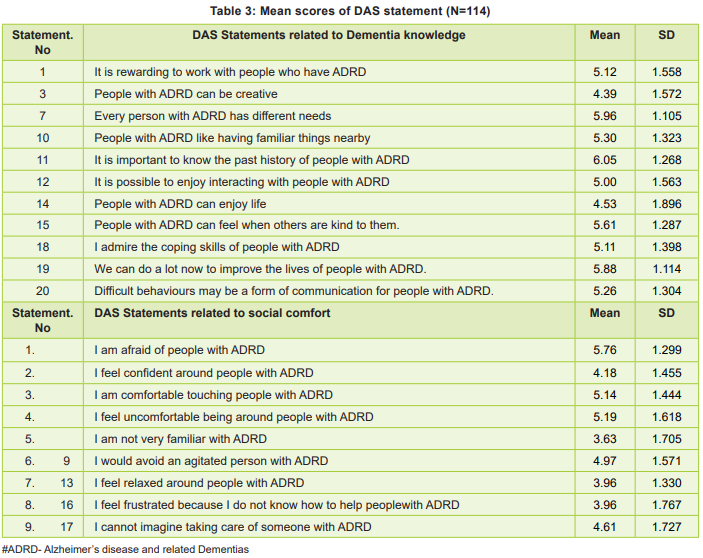
The mean DAS score was 99.63/140 (range:73-137, SD: 12.46), which suggested that neutral attitudes prevailed among the participants. The mean scores of each of the DAS statements are shown in Table 3, and the consolidated score of the two components of DAS, namely, Social Comfort and Dementia Knowledge, is shown in Table 4. Chi-square test showed no significant association between attitudes and socio-demographic variables.
Discussion
As shown in Table 1, it appeared that the participants in this study cannot recall having encountered people living with dementia at work or have never done so, which translates to fewer opportunities to provide dementia care. Moreover, they may not have been able to identify patients with dementia in their care, since almost all of them had no training in dementia, apart from one participant. People living with dementia in India are often diagnosed much after their symptoms appear, and some of them may never be diagnosed at all. So, the gaps in diagnosis or delays in diagnosis could be a reason for under-reporting of admission rates of people living with dementia (Lin et al, 2018). A lack of training contributed to nurses' inability to identify dementia in patients (Yaghmour, 2022).
Knowledge about dementia:
The mean knowledge score of the participants was only 27.45 (57.4%) out of 50, which indicates that the nurses in this study have inadequate knowledge of dementia. Similar findings were also reported where nurses have little knowledge of dementia, which is inadequate to provide the expertise to provide dementia care (Maen et al, 2022; Norbergh et al, 2006). The nurses in our study scored the lowest in the Communication and Behaviour sub-scale of the DKAS version 2. Inadequate knowledge and communication skills in caring for those who live with dementia affect nurses’ confidence in providing care (Evripidou et al, 2019).
Dementia attitudes:
The mean DAS score in this study indicated that the participants tend to have neutral attitudes towards dementia, though some may have positive and negative attitudes too. In some items of the Dementia Knowledge component, the mean score tends towards the total score of 7 (Table 3), which indicates that in some items participants had positive attitudes. While the mean scores of the Dementia Knowledge component of DAS in this study point towards negative attitudes, the mean scores of the Social Comfort component point towards neutral attitudes of nurses (Table 4).
Studies have shown that positive to neutral attitudes towards dementia among nurses and nursing students facilitated person-centred care, an essential aspect in dementia care (Sim et al, 2023; Hardman & Howick, 2019). It could also be implied that the participants in this study have intuitive empathy (Rand & Touza, 2018) towards people living with dementia, and empathy is shown to facilitate person-centred care (Hardman & Howick, 2019). Despite no training in dementia, nurses’ responses show that they do have some insight into dementia care, and their neutral attitude in general and positive attitude in some items could indicate hopeful thinking and their willingness to learn. Hopeful thinking helps in achieving desired goals (Rand & Touza, 2018), which, in this context, is better knowledge of dementia.
Nursing Implications:
The findings of this study can be used to explain the need for in-service education or short-term courses for nurses on dementia care to help them provide patientcentred care to people with dementia. The nursing curriculum also needs to incorporate dementia care as an essential module in nursing education. Hospital and nursing administrators can work together to close the gaps in dementia care through dementia-friendly protocols and dementia education for all healthcare professionals. Nursing research on interventional studies to improve the knowledge and attitudes of nurses on dementia care can be conducted.
Conclusion
While there is indeed a lack of knowledge on dementia, nurses’ attitude shows that they are inclined to learn if provided an opportunity. With the rising elderly population in India and an increasing prevalence of non-communicable diseases, including dementia, it is quite likely that nurses would frequently encounter people living with dementia in their practice. Therefore, nursing interventions to improve the knowledge and skills on dementia care is a need of the hour.
1. Nichols P, Steinmetz JD, Vollset SE, Fukutaki K, Chalek J, Abd-Allah F, et al. Estimation of the global prevalence of dementia in 2019 and forecasted prevalence in 2050: An analysis for the global burden of disease study. Lancet 2022; 7(2): e105-e125. https://www.thelancet.com/ journals/lanpub/article/PIIS2468-2667(21)00249-8/fulltext
2. World Health Organisation. Global action plan on the public health response to dementia 2017-25. Available from https://www.who.int/publications/i/item/globalaction-plan-on-the-public-health-response-to-dementia-2017-2025
3. Lee J, Meijer E, Langa KM, Ganguli M, Varghese M, Banerjee J, et al. Prevalence of dementia in India: National and state estimates from a nationwide study. Alzheimer's Dement 2023 Jul; 19(7): 2898-2912. doi: 10.1002/alz. 12928. Epub 2023 Jan 13. PMID: 36637034; PMCID: PMC10338640
4. National Statistical Office, Government of India, Ministry of Statistics and Programme Implementation. Key Indicators of Social Consumption in India: Health NSS 75th Round (July 2017-June 2018). November 2019. Available from - https://www.mospi.gov.in/sites/default/ files/publication_reports/KI_Health_75th_Final.pdf
5. Evripidou M, Charalambous A, Middleton N, Papastavrou E. Nurses' knowledge and attitudes about dementia care: Systematic literature review. Perspect Psychiatr Care 2019 Jan; 55: 48-60. DOI: 10.1111/ppc.12291. PMID: 29766513. Available from -https://europepmc. org/article/med/29766513
6. Nguyen AHP, Nguyen HV, Nguyen TX, Nguyen HTT, Nguyen TN, Nguyen TTH, et al. Knowledge, attitudes and confidence in providing dementia care to older adults among nurses practising in Hanoi, Vietnam: A cross-sectional study. Int J Older People Nurs 2024 Nov; 19(6): e12666. doi: 10.1111/opn.12666. PMID: 39526331; PMCID: PMC11663825
7. Zhao W, Moyle W, Wu MW, Petsky H. Hospital healthcare professionals' knowledge of dementia and attitudes towards dementia care: A cross-sectional study. J Clin Nurs 2022 Jul; 31(13-14): 1786-99
8. Singh J, Agrawal A, Kumari S, Tomar S, Karn A, Singh A. Knowledge of Alzheimer’s disease among the 2022 healthcare staff in a medical college hospital of India. J Family Med Prim Care Sep; 11(9): 5599-5603. doi: 10.4103/jfmpc.jfmpc_571_22
9. Strom BS, Engedal K, Andreassen L. Nursing staff’s knowledge and attitudes toward dementia: A pilot study from an Indian perspective. Dement Geriatr Cogn Disord Extra 2019; 9: 352-61. doi: 10.1159/000502770 Available from - https://www.karger.com/Article/FullText/502770
10. Ellajosyula R, Narayanan J, Hegde S, Kamath V, Murgod U, Easwaran V, et al. Delay in the diagnosis of dementia in urban India: Role of dementia subtype and age at onset. Int J Geriatr Psychiatry 2022; 37(12). doi: 10.1002/gps 5843. PMID: 36383431
11. Dookhy J, Daly L. Nurses’ experiences of caring for persons with dementia experiencing responsive behaviours in an acute hospital: A qualitative descriptive study. Int J Older People Nurs 2021; 16 (4): e12379. https://doi.org/10.1111/opn.12379
12. Lin PC, Hsieh MH, Chen MC, Yang YM, Lin LC. Knowledge gap regarding dementia care among nurses in Taiwanese acute care hospitals: A cross-sectional study. Geriatr Gerontol Int 2018; 18: 276-85
13. Yaghmour SM. Impact of settings and culture on nurses' knowledge of and attitudes and perceptions towards people with dementia: An integrative literature review. Nurs Open 2022 Jan; 9(1): 66-93. doi: 10.1002/ nop2.1106. Epub 2021 Oct 30. PMID: 34719132; PMCID: PMC8685848
14. Maen Aljezawi, Al Qadire M, Suliman Mohammad, Omari OA, Khalaf Atika. Undergraduate nursing students’ knowledge of and attitudes toward people with Alzheimer’s disease. BMC Geriatr 2022; 22(1); 691 https://doi.org/10.1186/s12877-022-03389-6
15. Norbergh KG, Helin Y, Dahl A, Hellzén O, Asplund K. Nurses' attitudes towards people with dementia: The semantic differential technique. Nurs Ethics 2006; 13 (3): 264-74. doi: 10.1191/0969733006ne863oa. PMID: 16711185
16. Sim SH, Kim GM, Kim EJ, Chang SJ. Types of empathy among certified caregivers of older adults with dementia. J Multidiscip Health 2023 Sep 13; 16: 2715- 31. doi: 10.2147/JMDH.S417315. PMID: 37724316; PMCID: PMC10505375
17. Hardman D, Howick J. The friendly relationship between therapeutic empathy and person-centred care. European Journal for Person Centred Healthcare 2019; 7: 351-57. Available from https://eprints.bournemouth.ac.uk/33107/
18. Rand KL, Touza KK. Hope Theory In: Snyder CR, Lopez SJ, Edwards LM, Marques SM (ed). The Oxford Handbook of Positive Psychology, 3rd edn. Online edition, Oxford Academic New York 2018: pp 425-42. https://doi. org/10.1093/oxfordhb/9780199396511.013.25
19. Hardman D, Howick J. The friendly relationship between therapeutic empathy and person-centred care. European Journal for Person Centred Healthcare 2019; 7: 351-57. Available from: https://eprints.bournemouth. ac.uk/33107/
20. Rand KL, Touza KK. Hope Theory. In: Snyder CR, Lopez SJ, Edwards LM, Marques SM. The Oxford Handbook of Positive Psychology, 3rd edn 2018. Online edition Oxford. Academic New York 2018: pp 425-42. https:// doi.org/10.1093/oxfordhb/9780199396511.013.25

This work is licensed under a Creative Commons Attribution-NonCommercial-ShareAlike 4.0 International License.