
Gaming has a long history that evolved alongside technological advancements. Early video games were simple, with basic graphics and limited functionality. As technology progressed, games became more complex and immersive, featuring detailed graphics and advanced mechanics tailored to players’ skills and preferences. Modern gaming fostered a competitive culture, particularly in esports and online communities, where players used high-end hardware and software to perform at elite levels. This competition drove innovation, prompting developers to create increasingly sophisticated systems that enhanced both gameplay and user experience.
In recent years, the world underwent a significant digital revolution, bringing transformative changes across sectors such as education, entertainment, and technology. In India, the government-led Digital India initiative aimed to promote digital empowerment and build a knowledge-based economy. Amid this transformation, online gaming emerged as a major force, reshaping the ways people connected, learned, and engaged in entertainment (Dhiman, 2023). Online gaming emerged as a vibrant and widely embraced form of digital entertainment in recent years. Its popularity grew rapidly, attracting individuals across various age groups and demographics. The accessibility of internetenabled devices and improved connectivity significantly contributed to this rise (Kuss, 2013).
nificantly contributed to this rise (Kuss, 2013). Over time, gaming became a central component of modern entertainment culture. It transformed how individuals spent their leisure time and how they interacted socially, both locally and globally. Online platforms enabled players to connect, collaborate, and compete in real time, redefining social engagement in the digital age (Seok & DaCosta, 2012).
As online gaming becomes a regular part of children’s daily lives, it is important to understand the extent and implications of this engagement. Sedentary behaviour and extended screen time associated with online gaming can lead to health issues like poor sleep quality, eye strain, headaches, and a higher risk of obesity. Online gaming can influence children’s cognitive abilities, emotional well-being, and social behaviour. While certain games may enhance learning and social interaction, excessive gaming is linked to addiction, aggression, anxiety, depression, and social isolation. A balanced understanding of these effects is vital to support healthy psychological development.
In a cross-sectional study on Internet Gaming Disorder (IGD) involving 200 first- and second-year medical students at Kurnool Medical College, Aruna Savanthe & Savolu Cynthia found that 10 percent of participants met the criteria for IGD, with significantly higher prevalence among males and those gaming more than 30 hours per week. The IGD-20 tool demonstrated high internal consistency (Cronbach’s alpha 0.91). Excessive gaming was strongly associated with socio-behavioural changes such as altered eating habits, increased hostility, and irritability (Singh et al, 2020). A recent case in India brought national attention to IGD, where a 12th grade student was granted permission by the Bombay High Court to retake an exam after his academic performance declined due to excessive gaming. What often begins as a casual hobby can escalate into a compulsive behaviour, disrupting daily routine, harming relationships, and hindering personal development. This incident underscores the urgent need for awareness and early intervention to mitigate the risks of gaming addiction in adolescents (Periz & Alvarez, 2024).
Physiologically, prolonged gaming can lead to disrupted sleep, reduced physical activity, and eye strain. Psychologically, it may affect cognitive development, emotional regulation, and social behaviour, with the potential to foster addictive patterns. This study aimed to assess the negative effects of internet gaming among schoolchildren, offering a balanced perspective to guide parents and educators. The ultimate goal is to support the development of strategies that promote healthy gaming habits and protect children’s overall development.
Need of the study:
Rising cases of internet gaming disorder (IGD) in India highlight its impact on academics and development (Kumari & Sharma, 2023). Adolescents are more vulnerable to internet gaming due to easy access and peer pressure. Our study examines the psychological and physiological effects of online gaming among adolescents in Kashmir.
Review of Literature
As related to the psychological effects: Singh et al (2020) conducted a cross-sectional descriptive study in two schools from the Sonitpur and Kamrup districts of Assam, using a convenience sampling method, and 409 adolescent participants were selected. Data were collected using the Online Gaming Addiction Scale and the Short Self-Regulation Questionnaire (SSRQ). The findings revealed a significant association between online gaming behaviour and emotional and behavioural problems among adolescents. The study emphasised the importance of psychosocial interventions at both individual and family levels to enhance self-regulation and mitigate gaming addiction among youth.
quantitative-correlational study in Angeles City, Philippines, using purposive sampling to investigate the relationship between online gaming addiction and mental health among 162 high school students. Data were gathered using the Depression, Anxiety, and Stress Scale (DASS-21) and the Internet Gaming Disorder Scale – Short Form. Results indicated that students heavily reliant on online gaming exhibited significantly higher levels of stress, anxiety, and depression.
As related to physiological effects: In a comprehensive survey involving 350 students aged 13-17 years, Verma & Goyal (2023) found that over 72 percent of participants played video games on various devices, including consoles, PCs, and mobile phones, accumulating a total of 662 gaming hours daily. While more than 70 percent reported that their outdoor and physical activities remained unaffected by gaming, 29.61 percent indicated a negative impact. Additionally, 51.8 percent expressed no interest in pursuing a career in gaming, potentially due to concerns about parental support or perceived lack of encouragement.
De Rosa et al (2024) conducted a systematic review to evaluate the relationship between adult video gaming and sleep outcomes. From an initial pool of 346 studies sourced through citation tracking and databases such as Scopus, PubMed, and PsycInfo, 53 were selected for abstract screening. After full-text evaluation, 26 studies were included in the final qualitative analysis. Of these, 12 reported negative effects of gaming on sleep, six identified positive or non-significant outcomes, and seven presented mixed results (Pontes & Griffiths, 2015).
Objectives
The study was set out with the objectives to assess the (1) level of online gaming addiction; (2) the physiological effects of online gaming; (3) psychological effects of online gaming among adolescents; and (4) to associate addiction levels with demographic variables.
Materials and Methods
A descriptive cross-sectional study was conducted from June to December 2024 in higher secondary schools in Kashmir, including Govt Higher Secondary School Bomai, Sopore; Unique Educational Institute Doru, Sopore; and Najmu-Sahar Higher Secondary School Doru, Sopore, Jammu & Kashmir. The schools were selected based on student population. All 200 adolescents, aged 13-18 years (80, 70, and 50 respectively), were selected using a convenience sampling technique. Data collection tools included the IGDS9-SF to assess gaming addiction, the DASS-21 (Krupanidhi, 2020) for psychological effects, and a self-structured questionnaire for physiological symptoms. Sociodemographic data were also recorded. Ethical approval and informed consent were obtained before data collection. Data were analysed using SPSS version 26.0, employing descriptive and inferential statistics, with Chi-square and Fisher’s exact tests applied at a significance level (p < 0.05).
Ethical approval:
Ethical approval for the study was obtained from the Institutional Ethics Committee. Written informed consent was obtained from all participants before data collection. The study was conducted in accordance with the principles outlined in the Declaration of Helsinki.
Results
More than half (51%) of adolescents exhibited gaming addiction behaviours. Physiological impacts were mild in 60.5 percent, moderate in 35 percent, and severe in 1 percent, with wrist/ neck pain and eye strain being the most common. Psychological outcomes showed 45 percent had normal depression, but 31 percent reported extremely severe anxiety. Addiction levels were significantly associated with class, frequency of gaming, and father’s occupation (p < 0.05).
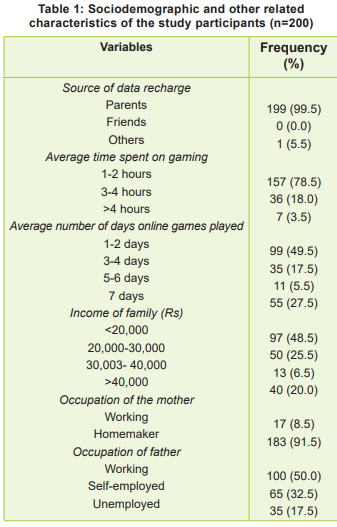
The demographic data showed (Table 1) that most respondents (n=152, 76%), were aged 15-16 years. Regarding gender, a slight majority of 106 (53%) were males. In terms of current class, 79 (39.5%) were in the 11th grade. Weight distribution indicated that 82 (41%) of participants weighed over 50 kg, while 81 (40.5%) had a height between 150 and 160 cm. Nearly all subjects, 199 (99.5%), relied on their parents for data recharge. Most participants (n=157, 78.5%), spent 1-2 hours daily on gaming. Approximately half (n=99, 49.5%), played online games 1-2 days per week. Regarding family income, 97 (48.5%) reported earning less than `20,000 monthly. Additionally, 183 (91.5%) of mothers were homemakers, and half of the respondents (n=100, 50%) had fathers who were employed.
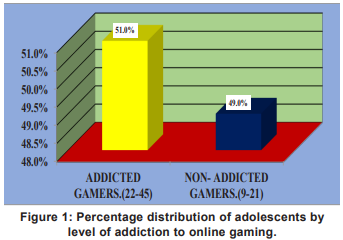
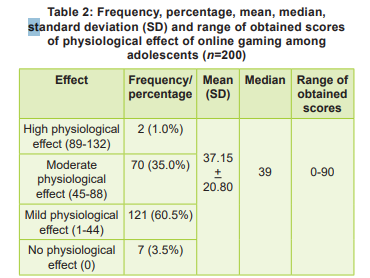
Based on the IGDS9-SF scale, 102 (51%) adolescents were classified as addicted gamers, while 98 (49%) were identified as nonaddicted gamers (Figure 1). Table 2 shows that the majority of adolescents experienced mild physiological effects, with 121 (60.5%) classified in this category. Additionally, 70 (35%) reported moderate physiological effects, while 7 (3.5%) had no physiological effects, and 2 (1%) experienced high physiological effects. The mean physiological
effect score was 37.15, with a median of 39. Scores ranged from 0 to 90, and the standard deviation (SD) was 20.80.
Figure 2 indicated that wrist and neck pain were the most commonly reported physiological issues among participants, with a modified mean score of 1.47. In contrast, Body Mass Index (BMI) concerns were the least prevalent, with a modified mean of 0.50. The physiological issues experienced
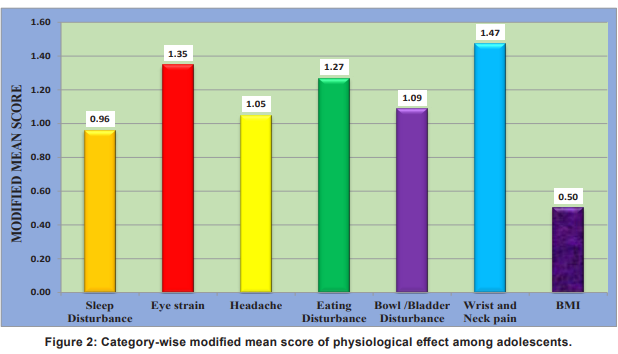
by adolescents, in descending order of prevalence, included eye strain (1.35), eating disturbances (1.27), bowel and bladder disturbances (1.09), headaches (1.05), and sleep disturbances (0.96).
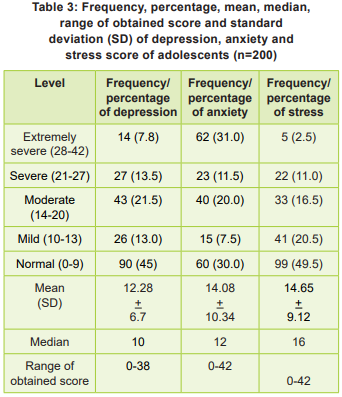
Table 3 shows that among the 200 respondents, 90 (45%) were classified within the normal depression category. Moderate depression was observed in 43 (21.5%) respondents, severe depression in 27 (13.5%), mild depression in 26 (13%), and extreme severe depression in 14 (7%). The mean depression score was 12.28, with a median of 10. Scores ranged from 0 to 38, with a standard deviation (SD) of 9.68. Regarding anxiety, 62 (31%) adolescents fell into the extremely severe anxiety category, while 60 (30%) were in the normal anxiety category. Additionally, 40 (20%) respondents experienced moderate anxiety, 23 (11.5%) severe anxiety, and 15 (7.5%) mild anxiety. The mean anxiety score was 14.08, with a median of 12. Scores ranged from 0 to 42, with an SD of 10.34.
As for stress, 99 (49.5%) respondents were categorised as normal, 41 (20.5%) experienced mild stress, 33 (16.5%) moderate stress, 22 (11%) severe stress, and 5 (2.5%) extreme severe stress. The mean stress score was 14.65, with a median of 16. Scores ranged from 0 to 42, with an SD of 9.12.
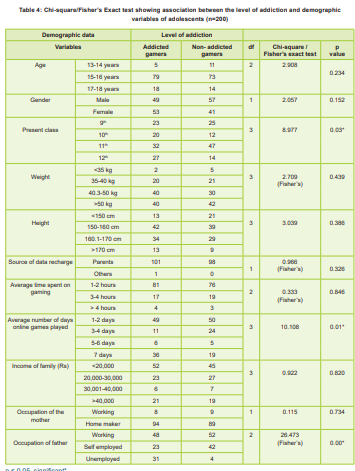
Data in Table 4 indicates a statistically significant association between the level of online gaming addiction and selected demographic variables, including current class (p=0.03), average number of days online games were played per week (p = 0.01), and father’s occupation (p = 0.00), as all values were at or below the 0.05 level of significance. However, no significant association was found between the level of addiction and other variables such as age, gender, weight, height, source of data recharge, average time spent on gaming, and family.
Discussion
Online gaming has significant psychological and physiological effects on adolescents. The high prevalence of anxiety and mild physiological effects aligns with previous studies highlighting risks of digital overuse. Its associations with demographic variables stress the need for targetted interventions.
The present study identified a significant correlation between the degree of online gaming addiction and several demographic variables, including current class (p = 0.03), average number of days games were played per week (p = 0.01), and the father’s occupation (p = 0.00). These findings are consistent with the results of a previous study conducted by Krupanidhi (2020), which examined the relationship between internet gaming addiction and physical health issues in early adolescence. That study also reported significant associations between online gaming addiction and selected demographic factors, such as age, gender, current class, and father’s educational level.
Nursing Implications
Promotion of healthy practices: Community and school health nurses should actively promote healthy lifestyle habits by educating adolescents about responsible internet use. Organising awareness programmes within educational settings can help mitigate the risks associated with gaming addiction.
Adolescent education: Nurses have a key role in guiding adolescents toward balanced technology use. They should provide targeted support to ensure that online activities contribute positively to mental, physical, and academic well-being.
Curriculum integration: Nurse educators should collaborate with teachers and school counsellors to address gaming addiction within academic institutions. Further, content related to behavioural addictions, as classified in DSM-5 and ICD-11, should be integrated into nursing curricula to prepare future nurses for early identification and intervention.
Limitations:
The study was conducted exclusively among adolescents from selected higher secondary schools; therefore, the findings cannot be generalised to other settings such as colleges or universities.
Recommendations
Based on the study’s findings, following recommendations are made to guide future research.
Larger sample size, diverse settings and age Groups: Future studies should consider involving a larger and more diverse population, and various age groups to enhance the generalisability of the findings. Exploration of associations: Further studies may investigate the relationship between the level of online gaming addiction and its physiological and psychological effects.
Age-based comparisons: Comparative studies between adolescents and young adults could provide deeper insights into age-specific patterns and impacts of gaming behaviour.
Gender-based analysis: Future research could employ a comparative design to examine differences in gaming addiction and its outcomes across different genders.
Conclusion
Online gaming was found to have measurable psychological and physiological effects on adolescents. To address these impacts, authors recommended the implementation of preventive strategies, awareness programmes, and schoolbased interventions aimed at encouraging balanced and healthy gaming habits.
1. Dhiman S. The transformative role of online gaming in Digital India. EGF Federation 2023; https://www.egf.org. in/the-transformative-role-of-online-gaming-in-digital-india
2. Kuss DJ. Internet gaming addiction: Current perspectives. Psychology Research and Behaviour Management 2013; 14(6): 125-37. https://doi.org/10.2147/PRBM. S39476. https://doi.org/10.2147/PRBM.S39476
3. Seok S, DaCosta B. The world’s most intense online gaming culture: Addiction and high-engagement prevalence rates among South Korean adolescents and young adults. Computers in Human Behaviour 2012; 28(6): 2143-51. https://doi.org/10.1016/j.chb.2012.06.019
4. Kumari D, Sharma V, Thokchom S. A cross-sectional study to assess the internet gaming addiction, problematic uses of the internet and sleep hygiene among young adults of selected colleges of nursing, Delhi. Journal of Advanced Medical and Dental Sciences Research 2023;11(5):92-99 https://scholar.google.co.in/citations?
view_op=view_citation&hl=en&user=MV95TY8AAAAJ&citation_for_ view=MV95TY8AAAAJ:3fE2CSJIrl8C
5. Singh Abhijeet, Ali AA, Choudhury Maria, Gujar NM. Online gaming and its association with emotional and behavioural problems among adolescents: A cross-sectional study. Archives of Mental Health 2020; 21(2): 71-76. https://journals.lww.com/amhe/fulltext/2020/21020/online_gaming_and_its_association_with_emotional.3.aspx
6. Periz Charlaine, Alvarez JJ. Relationship between online game addiction and mental well-being of high-school students during the Covid-19 Pandemic: Implications for learning and development: Quantitative correlation study. Journal of Learning for Development 2024; 11(2). https:// jl4d.org/index.php/ejl4d/article/download/1101/1070?inline=1
7. Verma Nalin, Goyal Vinay. Effects of digital gaming on the mental and physical health of teenagers: Extensive survey. International Journal of Advanced Research 2023; 11(08): 974-85. https://www.researchgate.net/ publication/374284468_effects_of_digital_gaming_on_ the_mental_and_physical_health_of_teenagers
8. De Rosa O, Baker FC, Barresi G, Conte F, Ficca G, et. al. Video gaming and sleep in adults: A systematic review. Sleep Med 2024; 124: 91-105 https://doi.org/10.1016/j. sleep.2024.09.015
9. Pontes HM, Griffiths MD. Measuring DSM-5 Internet gaming disorder: Development and validation of a short psychometric scale. Computers in Human Behavior 2015 April; 45: 137-43. https://doi.org/10.1016/j. chb.2014.12.006
10. Lovibond SH, Lovibond PF. Manual for the Depression Anxiety Stress Scales. 2nd edn, 1995. Psychology Foundation. https://www2.psy.unsw.edu.au/dass/
11. Krupanidhi S. A study to assess the internet gaming addiction and its relation with physical health problems among early adolescents: Descriptive-correlation study. International Journal of Applied Research 2020; 6(9): 234-38. https://www.allresearchjournal.com/archives/?- year=2020&vol=6&issue=9&part=D&ArticleId=7121
12. Noor HM, Omar MA, Ramli AM, Wong MSC. The effect of online gaming on the students’ sleeping pattern: A case study in University Malaysia Sabah. International Journal of Academic Research in Business and Social Sciences 2021: 11(5); 139-55. https://hrmars.com/index. php/papers/detail/MAJESS/9890/The-Effect-of-OnlineGaming-on-the-Students-Sleeping-Pattern-A-CaseStudy-in-University-Malaysia-Sabah
13. Aziz Norshakirah, Nordin MJ, Abdulkadir SA, Salih MMM. Digital addiction: Systematic review of computer game addiction impact on adolescent physical health. Electronics 2021: 10(9); 996. https://www.researchgate. net/publication/351048732_Digital_Addiction_ Systematic_Review_of_Computer_Game_Addiction_ Impact_on_Adolescent_Physical_Health
14. Solanki SR, Shukla RP, Dave VR, Rathod VG. Internet and gaming addiction, hikikomori trait and insomnia status among medical undergraduates at one of the cities of Western India: Cross-sectional study. Indian Journal of Community Health 2023: 35(1): 66-70. https://doi. org/10.47203/IJCH.2023.v35i01.012
15. Kamal NSZ, Wok S. The impact of online gaming addiction on mental health among IIUM students: Quantitative study. International Journal of Humanities, Arts and Medicine 2020: 3(11); 1-20. http://www.ijham. com/PDF/IJHAM-2020-11-12-01.pdf
16. Savanthe AM, Savolu CS. Internet gaming disorder: A public health concern. Intern Journal of Com Med & Public Health 2019; 6(8): 3532. DOI: 10.18203/2394-6040. ijemph20193483

This work is licensed under a Creative Commons Attribution-NonCommercial-ShareAlike 4.0 International License.